Showing posts with label Diane Ragsdale. Show all posts

Tuesday, March 15, 2011

Theater Terroir: Applying an Agricultural Model to Theater Making

A few months ago, in response to the cancellation of the Shakespeare in the Park program, I became obsessed with cultivating a model for my theater group that would work.  Initially spurred by Ken Robinson's TED talk  I wondered if I ought to find an agricultural model to apply to making theater.

This was happening around October and November, while the Sierra Foothills bustled with harvest festivals featuring locally grown produce and wine.  I do love wine.  There is something very special about the wine region in my neighboring counties.  Though largely lacking  in infrastructure to support tourists (which could be viewed as part of its charm) the region is peppered with Mom and Pop vineyards who welcome tasters with the small town hospitality that one only expects to see in fiction.

Inspired by the attitude of these area wineries, I decided to learn a little more about making wine.  I read an excellent book, Passion on the Vine by Sergio Esposito, and began to think about the lessons the book preached about winemaking in terms of making theater.  What resulted was a vision statement for another theater model.  Since this blog is all about setting ideas free, I'd like to share my idea with you.


Theater Terroir Vision Statement
Imagine a theater that creates its art in the same way the greatest vintners create their wine; a theater so ingrained in its community that the sense of the place in which it is cultivated becomes reflected in the character and structure of its art.  This is the embodiment of Community Theater---one that, like wine, must produce its plays in a way that best reflects its own terroir.

Terroir is a French loanword with no exact English translation but has often been defined as “a sense of place.”  Aspects that define a wine’s terroir include the topography, climate, soil type and the neighboring plants that grow in and around the vine plots.  When we think of applying the concepts of terroir to our theater company, we must consider them both literally and metaphorically:

Topography
When producing local theater, the topography of the land dictates the spaces and backdrops in which the theater grows, develops, matures and (finally) produces its plays.  Our theater’s topography includes Johnson-Springview Park, where we have rehearsed and produced works of Shakespeare for the past 5 years.  However, the geographic space that nurtures our art spreads farther and deeper into the community. 

Our topography includes those places where our artists interact with our audiences without distinguishing themselves in these roles.  These are the places that provide the issues and events we can draw upon to create our art, like the soil where the grapevine draws its nutrients.  Some places will not be as easy to thrive in as others, but it is said that some of the best grapes are produced in the rockiest topography.  This is a fact to keep in mind if ever we are faced with hardships in producing our local theater.

Climate
To truly understand the concept of climate in creating local theater we must evaluate its human factors.  When developing our plays, we must be alert to the present political, social and economic climates in our region.  To capture the theater’s terroir, each vintage (or play) must be relevant and applicable to the current climates.  Our plays will work to stimulate discussion, provide opportunities for dialogue and nurture understanding of different viewpoints within our community.  If done successfully, we expect that the vintages left to age on the shelf for a few years will provide a taste of our cultural history when sipped by future readers.

Soil Type
Though the art of theatermaking typically does not include interacting with the soil itself, we appreciate “soil type” as a metaphor for our local history.  As luck would have it, a great deal of Rocklin’s history is inexorably linked to what lies in the soil beneath our feet.  The same can be said for the history of the rest of the region, which was often nicknamed “Gold Country.”  To dig in our roots and keep in touch with the soil that is our history, we plan to release one historical play each year.  Consider it like one of our grape varieties indigenous to the region.  We hope that this goal will build lasting partnerships with our local museums, educators and historical societies.

Neighboring Plants
Finally, to embrace our terroir we must not be blind to the neighboring artists and cultural organizations that pepper our region.  One famous winemaker laid out his winery like a botanical garden: including other types of fruits and plants so that “the vines could have friends.”  If we are to produce our theater organically, we must also be open to cooperative partnerships with the other beneficial organizations in our area.  Living in the same place with the shared goal of improving it makes for supportive friendships and results in great collaborative creation.

With these principles of terroir in mind, we hope to become great community theatermakers.  Our goal is to produce unique plays that reflect the cultural character of our community and to enrich that cultural experience by stimulating discussion, dialogue and different viewpoints about the area in which we live.

---

Later, I was led to the brilliant work of Diane Ragsdale and read her arguments for a Slow Food Movement as applied to the arts in her speech, The Excellence Barrier.  For others interested in devising a theater model that is more agricultural than industrial, I highly recommend you read this.

Thoughts? Ideas? Questions?  You are always welcome to contribute to this blog by adding to the comments section!

Photo of vineyards provided by http://www.sierrawineries.com

Wednesday, March 9, 2011

Improving the “Typical" Theater Experience Part One: Audience

In a world where nearly all forms of entertainment are accessible by computer or smart phone it is easy to view the act of seeing a play as something not only inessential, but downright obsolete.  In one sense, I agree.  Why should you pay upwards of twelve bucks to see The Sound of Music (or A Midsummer Night’s Dream, for that matter) for the umpteenth time when Oscar’s 2011 Best Picture is still playing at the local movie theater for the same price?  

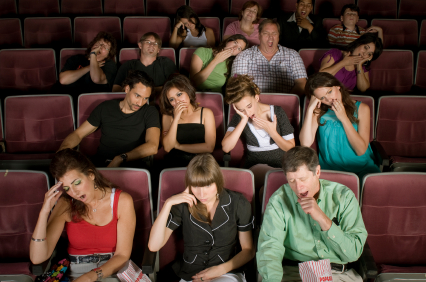
If we are discussing most theater as we know it today, in both experiences you will be sitting in a dark room and required to be mostly passive and silent.  Perhaps the show will be entertaining and you will feel a sense of camaraderie with others in the audience who are laughing along with you during the performance/movie, but when the lights go up, then what?  Maybe you’ll be able to applaud at the live show and talk to a few actors who will politely nod before moving on to their friends and family, but in both the live theater and movie theater scenario you will likely leave the building with a head full of thoughts and opinions and no where to put them.

Though I cannot speak for everyone, I would call this my “typical theater experience” as an audience member.  This is not to critique the quality of the writing or acting in the plays I’ve seen, because so many have been excellent, but I usually leave the theater with a slight feeling of emptiness.  Correct me if I’m wrong, but I don’t think I’m alone in this.

So why does the experience need improvement?

If we focus a little bit on the movie theater model, it’s easy to measure success.  Looking at content, the highest grossing film of all time is James Cameron’s Avatar.  The draw for repeat viewings of this film was the fact that the 3D experience was vastly superior in the theaters; so much so that the film was re-released a few months later for a second triumph at the box office.  Audiences raved about the special effects and gave credit to advances in filmmaking technology.  The film was not the stand-out in writing, acting or plot (different films took home the Oscars that year) but the experience of watching the film was revolutionarily innovative for the industry.

By comparing** financial success in the movie industry with theater, the point I’m trying to make is not that live theater needs to heavily invest in special effects but that much more importance needs to be placed on the audience experience.  When I say that the “typical theater experience” needs to be improved upon, I am speaking specifically to that sense of alienation and emptiness generated in audience members leaving the theater after a performance.

At the beginning of this blog I noted that the increase in access to entertainment (thanks to ever-advancing technology) may be making the need for live theater obsolete.  However, this technology only makes entertainment broadly accessible at the individual level.  In other words, I don’t see large groups of people getting together in one room to watch their favorite TV show on their individual iPads… yet.

What I do see (and participate in) are social meetings on a virtual plane.  Facebook is the greatest example of this kind of activity, where people log in to be social on their own time.  They may not have direct contact with their friends, but they leave messages that produce a similar (if not slightly more superficial) sense of socialization.  Diane Ragsdale notes in her article, Recreating Fine Arts Institutions that “Americans live in an increasingly free, time-shifting, do-it-yourself culture.  Fully half of all teens have created a blog or Web page, posted original artwork, photographs, stories or videos online, or remixed online content into their own creations.”  In these terms, our culture has never before had a stronger sense of creativity, yet little of it seems to be transferring to the audience experience at the local theaters.

Is it possible for theaters to harness the creativity of their audiences?  Can technology that is used to create virtual social spaces enhance the social experience of audience members who are together in a physical space?  By embracing what technology has facilitated in America as a culture of change, can theaters adapt their models to not only be more elastic but also allow for DIY participation from their audiences?

Yes.  Yes.  Yes.

I believe it is entirely possible for theaters to do all of these things.  The first step is simply allowing the public to participate in multiple levels of engagement at strategic points along the artistic process.  To illustrate what I mean, I will list examples and place them on something I call “the active engagement scale.”  

Ms. Ragsdale details one example:
“Four years ago, Chicago’s Steppenwolf Theatre launched First Look 101, in which they invite 101 patrons to join them at important steps of developing a new play.  Most arts organizations offer behind-the-scenes opportunities only for major donors.  First Look 101, however, is affordable ($45 for students and $75 for others) and open to anyone.  The three-month program gives people the chance to attend an unrehearsed table reading, the first day of rehearsal (including designer presentations), a rehearsal involving blocking an scene work, a technical rehearsal (when elements such as lights and sound are incorporated), and a final performance.”

This example is what I would designate to the lower end of the active engagement scale.  Though the program demystifies the artistic process and allows audiences to look at and listen to what the theater is doing in the stages before opening night, they are not asked to give feedback nor are they given opportunities to create.

Arena Stage also developed a “First Look” style program called “Theater 101” but added an important component.  They note on their site that “each event will be followed by a discussion moderated by Arena artistic staff.”  The discussion opportunity raises this program to the moderate level of engagement on the scale as audiences are given a chance to express their opinions and ideas.  Still, the creativity of the audience is left largely untapped.

Because so many opportunities for creative expression are available online, I think one of the easiest ways for audiences to reach the high end of the active engagement scale (where they are observing, reflecting, expressing AND creating) is to give them a voice on the theater organization’s website.  One example of this comes from On the Boards, who invited “members of their community” ---including audience members--- to publish their impressions about performances on the Blog the Boards section of the organization’s website.  Risky?  Possibly, though it appears blog posts were moderated to prevent any personal attacks.  Successful?  It appears so!  There was a large quantity of blogs (spanning several years) and those I clicked at random were insightful and well-written: a definite improvement on most fan forums I’ve seen in the past.


Another example of high active audience engagement would be performances that actually take audience volunteers to participate in the show.  Improvisational comedy (like that on Whose Line is it, Anyway?) is often reliant on audience suggestions and ideas to craft the performance.  Productions that follow the format of Augusto Boal’s Theatre of the Oppressed allow audience members to “pause” a performance and step into the action on stage in order to solve the problems created by the actors in the scene.  In both examples, audiences can voice their opinions and suggestions to directly affect the show and create new outcomes.

All of these examples are given to show that theaters are trying interesting and innovative techniques to engage their audiences at multiple levels of activity.  Perhaps these specific methods are not all appropriate for my local theaters, but they certainly help to get ideas flowing.

In a culture of change, it is important that the theater experience does not fall into the category of “typical.”  We are all far too creative for redundancy.

**Supplementary Explanation of Comparing For-Profit to Non-Profit Businesses:
Most live theater organizations are not for-profit businesses, so it is not always easy to draw accurate comparisons.  For a movie theater, the audience decides with their dollars about what appeals to them, but the measure of a non-profit’s success is a little more complex.   To begin, a non-profit, while allowed to make a profit (or more accurately, a “surplus”), cannot distribute that income to its members (the equivalent of this would be a corporation paying dividends to its share holders).  Those earnings must be retained by the organization for its self-preservation, expansion and future plans.

With this in mind, the first priority of a non-profit organization (by law) is to its mission.  Mission statements for non-profit theaters fall under the “Public Benefit Non-Profit Corporation” category, which is restricted to “businesses formed for scientific, charitable, literary, or educational purposes.”  The following is an example of a non-profit theater’s mission statement:

[City Name] Rep's mission is to stimulate, celebrate and enhance understanding of ourselves and others through the shared experience of live theatre by producing new plays and classics marked by innovative interpretations and a reflection and inclusion of our community and the world in which we live.

The key phrase in this statement is “enhance understanding” which relates to the “educational purpose” aspect of a non-profit mission statement.  If the theater achieves its mission through its operations, one could argue that it is a successful non-profit, even if it has lost money.  Of course, if the non-profit continues to lose money it will not be able to maintain the operations that achieve its mission, therefore a positive revenue stream can be a supplementary measure of the non-profit’s lasting success.

In contrast, the basic “mission” of a for-profit business is simply to make a profit.  The commonality is that not losing money helps both kinds of businesses, no matter where their priorities lie.