Showing posts with label Technology. Show all posts

Monday, June 20, 2011

Marketing Monday: Mobile Takeover! Expect SoLoMo Gamification to Explode.

Last Monday I wrote about the need for theaters (and others) to accept and utilize mobile marketing---even during shows/movies.  This week I have a few more numbers to back this claim.


According to a study published on Flurry this morning, the minutes U.S. consumers spend on their mobile apps has eclipsed the number of minutes they spend on the web, though both continue to rise.  Here's the chart:


Here's what Flurry reports U.S. mobile users are doing while they're on their mobile apps:


Gaming and social networking are, by far, the most common practices on Mobile Apps right now.


SoLoMo and the Rise of "Gamification"


SoLoMo stands for social, local and mobile.  The "gamification" of apps is a surefire way to engage a new generation of audiences, and by adding a gaming layer to social-local-mobile interaction, marketers are creating ways to get the biggest piece of the mobile pie.  


With geolocation applications and services like Foursquare, Gowalla, Loopt and BrightKite, as well as virtual check-ins on Twitter, Facebook and beyond, the convergence of SoLoMo is creating a whole new way to market.  These applications are social first, gaming second.  But what about apps that reverse the equation?


SCVNGR is location-based gaming first, social second.  While you can easily connect the game to social platforms like Facebook and Twitter, SCVNGR makes check-ins a mere gateway to a set of games and challenges designed for specific locations.


Take a look at a set of challenges for American Apparel:


The check-in is worth +1 point, while the main challenge (taking a picture of yourself posing like a mannequin) is worth +5.  The social aspects, such as sharing the picture or sharing the useful note you wrote about the store for the +2 points, are secondary.

The app is young, however, and has run into problems with implementation and follow-through.  It seems that if you wish to create a successful experience on SCVNGR, you have to do it yourself.


Here's a link on how to start a marketing campaign on SCVNGR.


 Geocaching, however, is also a game first, social second type of application.  It has been around a long time (11 years!) and is already active on all seven continents.  By putting a Geocache at the site of your business, you put yourself on their map for users to find.


Existing cache types allow for a game play, including:

  • Mystery/puzzle: This cache requires one to discover information or solve a puzzle to find the cache. Some mystery caches provide a false set of coordinates with a puzzle that must be solved to determine the final cache location. In other cases, the given location is accurate, but the name of the location or other features are themselves a puzzle leading to the final cache. Alternatively, additional information is necessary to complete the find, such as a padlock combination to access the cache.
  • Multi-cache: This variation consists of multiple discoveries of one or more intermediate points containing the coordinates for the next stage; the final stage contains the log book and trade items.
  • Event Cache: This is a gathering organized and attended by geocachers. Physical caches placed at events are often active only for the event date.

Idea for Adding a Game Layer to Traditional or Existing Caches:

  • QR or Scannable Codes.  Include these as a sticker on the inside or outside of your geocache.  When the code is scanned, users are linked to your website with your personal game challenges.  You can also link straight to a game located on the web.
GPS services aside, I'm still going to herald the potential of QR Codes, especially for entertainment events.  What if you're the lucky patron at a show (movie, theater, concert or other) with a QR code under your seat that gets you a free drink at the snack bar?  Or an upgrade to a backstage pass?  The basis for all of these social gaming platforms is the possibility of earning a reward, be it virtual (like 4square mayorship) or in real life.

Things to think about.

PS.  Since my brother designs mobile apps, you may be see the Theater Friendly App available in the near future.  

Tuesday, June 14, 2011

Tech Tuesday: Google Instant Search Conference Reveals Cool New Tools

I postponed today's blog post last night in anticipation of the Google Instant Search press conference which was streamed live from San Francisco this morning.  I'm glad I did, because they revealed three seriously cool new tools.

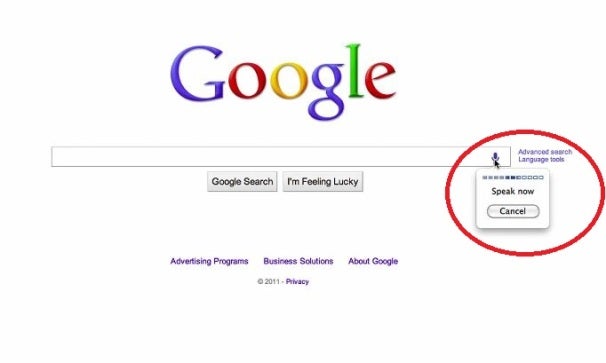
1. Instant Search Using Voice : 


How Voice Search will appear.
Click to enlarge.
Now you don't even have to type your search queries.  Just clicking on the microphone button in the search bar will enable you to speak your search request.  This is helpful when you don't know how to spell the words or more likely, the names of who/what you wish to search for.

It should be noted that this feature was already available and popular for mobile devices, but now is coming to your desktop on the Chrome browser.  Google's voice search traffic has risen six-fold in the past year, an increase that speaks to the popularity of speech recognition on mobile devices. It will be interesting to see if desktop and laptop PC users show the same enthusiasm for voice input.


2. Instant Search Using Images enables users to drag-and-drop, copy-and-paste image URL, or upload the image from the desktop into the search box. They can also use a Chrome or FireFox software extension to add images to the search. 


Google said the search-by-image feature will be available in most countries and regions over the next few days to Chrome users, noting that it will not collect and store any images that users use.

3. Instant Pages pre-renders Websites when it's confident you'll click on the top result of a query. In a demonstration today, pages loaded immediately when using Instant Pages, while an old version of Google search took an extra three or four seconds. Even when pages don't load immediately, they load a few seconds faster using Google Instant Pages.
The feature will be available today in the developer version of Google's Chrome browser, and this week in Chrome's beta version. Instant Pages will come to the stable version of Chrome and mobile browsers in the coming weeks. Because the code is open source, developers can build Instant Pages extensions for other browsers as well.  
"Uh... that's cool, but what does this have to do with theater ideas?"  
Good point.  Let's imagine.
Image Search-
You're a costume designer and have finished the latest round of sketches for the cast of A Streetcar Named Desire.  After scanning them into your computer (unless you work primarily on a drawing tablet already) you drag the sketch into the search bar.  Immediately, shopping results for vintage clothing that look exactly like what you sketched Blanche in pop up, and you're able to find the best deal.
OR
You're a theater director in Oregon planning on touring a production of Shakespeare's a Midsummer Night's Dream in an outdoor setting in Virginia.  You want to scout a location that has the same curving trees and ground cover as your neighborhood park.  You take a photo of the Oregon location, drag it into the search bar, and find a great match at a Virginia country club complete with booking information.
OR
You're a location scout for a film project and you need to find a building in town that looks enough like the high school the script is based on 100 miles away...  
You see where I'm getting at.
Voice Search and Instant Pages provide more general conveniences.  Instant Pages save seconds of time, but they add up.  Perhaps that time saved only allows a person to make one extra search each day, but that search might be for you.
Voice Search is mostly useful when you don't know how to spell something, like the name of the Russian actor you're supposed to locate for your theater's next production of Uncle Vanya.  To be honest, when Voice Search allows me to go completely hands free and talk to my computer like a Star Trek character while I'm hand stitching a costume, I'm going to get far more excited.  

PS.  All information in this article was obtained from the notes I took while watching the Google Instant Search conference.  The images are courtesy of Google Instant.

Thursday, May 19, 2011

Theater Marketing Using 3 Social Networks: Proudly Presented in Bullet Points!

Hey there!  Dramatic Dissemination is back with more big Idea Blogs.  Today's topic covers ways to use three social networking sites to market your theater.  Off we go!

Facebook
  •          You have to create a page for your theater on facebook.  With over 500 million users, the website’s population is larger than every country except for India and China.  If you want to be seen, you have to be there.
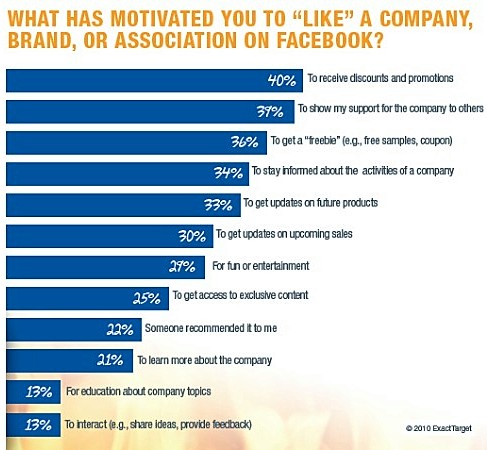
  •          However, when you make your page, keep in mind that the number one reason (at 40%)  facebook users “like” pages is for the purpose of obtaining exclusive promotions and discounts.  You have to give away a little on your facebook page to earn loyalty from your fans.  See the graph below for more reasons people will “like” you.


  •          Work to create true fans.  This means building a relationship with your fan base that allows them to identify with your brand.  Do not use your page for the sole purpose of impersonal updates like “come to our next show!”  or “great job everybody!”  Use your status updates to engage in a conversation with your fans, respectfully discuss their feedback and build a sense of identity between your fans and the culture of your theater.
  •         Set up a store on your facebook page. True fans want every chance they can get to show that they are a part of your theater.  Use that loyalty to promote your brand and bring more like minds into the fold.  Facebook stores typically secure 1-10% of a business’ fan base.  For a little perspective: in the 4th quarter of 2010, online sales were a record breaking $43.4 billion, +11% versus one year ago, according to comScore.


Twitter
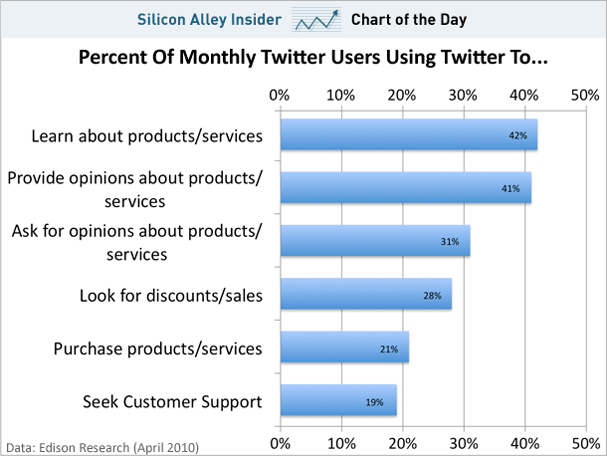
  •          Over 40% of the time that people are on Twitter, they are learning about products and services or providing opinions about brands.  If you aren’t on Twitter, they won’t be tweeting about you.
  •          Shocker: People actually spend a little over 20% of their time on Twitter BUYING products or services.  Again, if you aren’t on Twitter, the tweeters aren’t spending that purchasing power on you.  You’re missing out on ticket sales.  For other interesting ways that people are spending their time on Twitter, check the graph below.


  •        YouTube is the second largest search engine in the world.  Do you have a product or service that can be featured in front of a camera?  If you’re a theater, I have a feeling you do.  Get a YouTube channel for your theater, but read the Terms of Service agreement so that you understand what can happen to your content. 
  •          Content ownership technically belongs to the users, but YouTube's Terms of Service allows YouTube the licensing rights to use your content as they please until you delete it from the site.  So rather than uploading complete performance recordings that you are trying to sell, give samples and trailers.  Use Youtube for informational webcasts, behind-the-scenes bonuses, interviews with the artists and teasers for upcoming events.  Feature highlights from VIP parties for those valuable loyal fans and allow fans to upload their own footage from these events. 
  •          Always link these videos back to your main website, where you can feature/sell/rent your exclusive content.
  •          BONUS: A great idea that has yet to be used by a theater (at least to my knowledge) is a play, scene or passage done in the style of Virtual Choir.  I’ve certainly toyed with the idea of using this technique to produce an online version of Hamlet… or use it for an original play!

There are certainly more social networks to cover, but I’ve decided to keep my posts briefer in order to get them posted more frequently.  Speaking of social networks, why not connect with me on LinkedIn if you’d like to continue the conversation?  http://www.linkedin.com/in/danielleloebs

(Graph of “What has motivated you to “like” a company, brand or association on facebook?” courtesy of ExactTarget.  Chart of “Percent of Monthly Twitter Users Using Twitter To…” courtesy of Silicon Alley Insider from data collected by Edison Research.)

Wednesday, March 9, 2011

Improving the “Typical" Theater Experience Part One: Audience

In a world where nearly all forms of entertainment are accessible by computer or smart phone it is easy to view the act of seeing a play as something not only inessential, but downright obsolete.  In one sense, I agree.  Why should you pay upwards of twelve bucks to see The Sound of Music (or A Midsummer Night’s Dream, for that matter) for the umpteenth time when Oscar’s 2011 Best Picture is still playing at the local movie theater for the same price?  

If we are discussing most theater as we know it today, in both experiences you will be sitting in a dark room and required to be mostly passive and silent.  Perhaps the show will be entertaining and you will feel a sense of camaraderie with others in the audience who are laughing along with you during the performance/movie, but when the lights go up, then what?  Maybe you’ll be able to applaud at the live show and talk to a few actors who will politely nod before moving on to their friends and family, but in both the live theater and movie theater scenario you will likely leave the building with a head full of thoughts and opinions and no where to put them.

Though I cannot speak for everyone, I would call this my “typical theater experience” as an audience member.  This is not to critique the quality of the writing or acting in the plays I’ve seen, because so many have been excellent, but I usually leave the theater with a slight feeling of emptiness.  Correct me if I’m wrong, but I don’t think I’m alone in this.

So why does the experience need improvement?

If we focus a little bit on the movie theater model, it’s easy to measure success.  Looking at content, the highest grossing film of all time is James Cameron’s Avatar.  The draw for repeat viewings of this film was the fact that the 3D experience was vastly superior in the theaters; so much so that the film was re-released a few months later for a second triumph at the box office.  Audiences raved about the special effects and gave credit to advances in filmmaking technology.  The film was not the stand-out in writing, acting or plot (different films took home the Oscars that year) but the experience of watching the film was revolutionarily innovative for the industry.

By comparing** financial success in the movie industry with theater, the point I’m trying to make is not that live theater needs to heavily invest in special effects but that much more importance needs to be placed on the audience experience.  When I say that the “typical theater experience” needs to be improved upon, I am speaking specifically to that sense of alienation and emptiness generated in audience members leaving the theater after a performance.

At the beginning of this blog I noted that the increase in access to entertainment (thanks to ever-advancing technology) may be making the need for live theater obsolete.  However, this technology only makes entertainment broadly accessible at the individual level.  In other words, I don’t see large groups of people getting together in one room to watch their favorite TV show on their individual iPads… yet.

What I do see (and participate in) are social meetings on a virtual plane.  Facebook is the greatest example of this kind of activity, where people log in to be social on their own time.  They may not have direct contact with their friends, but they leave messages that produce a similar (if not slightly more superficial) sense of socialization.  Diane Ragsdale notes in her article, Recreating Fine Arts Institutions that “Americans live in an increasingly free, time-shifting, do-it-yourself culture.  Fully half of all teens have created a blog or Web page, posted original artwork, photographs, stories or videos online, or remixed online content into their own creations.”  In these terms, our culture has never before had a stronger sense of creativity, yet little of it seems to be transferring to the audience experience at the local theaters.

Is it possible for theaters to harness the creativity of their audiences?  Can technology that is used to create virtual social spaces enhance the social experience of audience members who are together in a physical space?  By embracing what technology has facilitated in America as a culture of change, can theaters adapt their models to not only be more elastic but also allow for DIY participation from their audiences?

Yes.  Yes.  Yes.

I believe it is entirely possible for theaters to do all of these things.  The first step is simply allowing the public to participate in multiple levels of engagement at strategic points along the artistic process.  To illustrate what I mean, I will list examples and place them on something I call “the active engagement scale.”  

Ms. Ragsdale details one example:
“Four years ago, Chicago’s Steppenwolf Theatre launched First Look 101, in which they invite 101 patrons to join them at important steps of developing a new play.  Most arts organizations offer behind-the-scenes opportunities only for major donors.  First Look 101, however, is affordable ($45 for students and $75 for others) and open to anyone.  The three-month program gives people the chance to attend an unrehearsed table reading, the first day of rehearsal (including designer presentations), a rehearsal involving blocking an scene work, a technical rehearsal (when elements such as lights and sound are incorporated), and a final performance.”

This example is what I would designate to the lower end of the active engagement scale.  Though the program demystifies the artistic process and allows audiences to look at and listen to what the theater is doing in the stages before opening night, they are not asked to give feedback nor are they given opportunities to create.

Arena Stage also developed a “First Look” style program called “Theater 101” but added an important component.  They note on their site that “each event will be followed by a discussion moderated by Arena artistic staff.”  The discussion opportunity raises this program to the moderate level of engagement on the scale as audiences are given a chance to express their opinions and ideas.  Still, the creativity of the audience is left largely untapped.

Because so many opportunities for creative expression are available online, I think one of the easiest ways for audiences to reach the high end of the active engagement scale (where they are observing, reflecting, expressing AND creating) is to give them a voice on the theater organization’s website.  One example of this comes from On the Boards, who invited “members of their community” ---including audience members--- to publish their impressions about performances on the Blog the Boards section of the organization’s website.  Risky?  Possibly, though it appears blog posts were moderated to prevent any personal attacks.  Successful?  It appears so!  There was a large quantity of blogs (spanning several years) and those I clicked at random were insightful and well-written: a definite improvement on most fan forums I’ve seen in the past.


Another example of high active audience engagement would be performances that actually take audience volunteers to participate in the show.  Improvisational comedy (like that on Whose Line is it, Anyway?) is often reliant on audience suggestions and ideas to craft the performance.  Productions that follow the format of Augusto Boal’s Theatre of the Oppressed allow audience members to “pause” a performance and step into the action on stage in order to solve the problems created by the actors in the scene.  In both examples, audiences can voice their opinions and suggestions to directly affect the show and create new outcomes.

All of these examples are given to show that theaters are trying interesting and innovative techniques to engage their audiences at multiple levels of activity.  Perhaps these specific methods are not all appropriate for my local theaters, but they certainly help to get ideas flowing.

In a culture of change, it is important that the theater experience does not fall into the category of “typical.”  We are all far too creative for redundancy.

**Supplementary Explanation of Comparing For-Profit to Non-Profit Businesses:
Most live theater organizations are not for-profit businesses, so it is not always easy to draw accurate comparisons.  For a movie theater, the audience decides with their dollars about what appeals to them, but the measure of a non-profit’s success is a little more complex.   To begin, a non-profit, while allowed to make a profit (or more accurately, a “surplus”), cannot distribute that income to its members (the equivalent of this would be a corporation paying dividends to its share holders).  Those earnings must be retained by the organization for its self-preservation, expansion and future plans.

With this in mind, the first priority of a non-profit organization (by law) is to its mission.  Mission statements for non-profit theaters fall under the “Public Benefit Non-Profit Corporation” category, which is restricted to “businesses formed for scientific, charitable, literary, or educational purposes.”  The following is an example of a non-profit theater’s mission statement:

[City Name] Rep's mission is to stimulate, celebrate and enhance understanding of ourselves and others through the shared experience of live theatre by producing new plays and classics marked by innovative interpretations and a reflection and inclusion of our community and the world in which we live.

The key phrase in this statement is “enhance understanding” which relates to the “educational purpose” aspect of a non-profit mission statement.  If the theater achieves its mission through its operations, one could argue that it is a successful non-profit, even if it has lost money.  Of course, if the non-profit continues to lose money it will not be able to maintain the operations that achieve its mission, therefore a positive revenue stream can be a supplementary measure of the non-profit’s lasting success.

In contrast, the basic “mission” of a for-profit business is simply to make a profit.  The commonality is that not losing money helps both kinds of businesses, no matter where their priorities lie.