Showing posts with label True Fans. Show all posts

Friday, May 20, 2011

Identifying and Creating True Fans (to Market Your Theater)

I’m going to try to keep up with my bullet point format on this one, but first, a little bit of background.
The concept of true fans is not new.  One of the most prominently blogged about opinions for what defines a “true fan” comes from Kevin Kelly, who suggests that individual artists need only maintain 1,000 true fans in order to make a living.  Kelly writes:

Example of a True Fan of Rubik's Cubes
courtesy of Hardware Sphere
“A True Fan is defined as someone who will purchase anything and everything you produce. They will drive 200 miles to see you sing. They will buy the super deluxe re-issued hi-res box set of your stuff even though they have the low-res version. They have a Google Alert set for your name. They bookmark the eBay page where your out-of-print editions show up. They come to your openings. They have you sign their copies. They buy the t-shirt, and the mug, and the hat. They can't wait till you issue your next work. They are true fans.”

An Apple True Fan.
Courtesy internetevolution.com
The math is simple, if a True Fan will spend $100/year on your work, and you net 1,000 true fans, an income of $100,000 per year will certainly allow you to live comfortably off of your art.  Sadly, the math is actually a little TOO simple.  I recommend that artists who consider this route for success read Kelly’s follow-up post, The Reality of Depending on True Fans, which crunches real numbers from a prolific musician who has used this strategy.  The short answer is that you may need more than 1,000 true fans if you aren’t making enough high-valued art to get $100 out of them each year.

But the original point of this post was about identifying and creating true fans to help you market your theater, so let us take a look at the strategies from the world’s best marketed brand: Apple.  Bullet points commence!

Applying Apple’s Strategies to Identify and Create True Fans

Apple Strategy 1: Don’t Sell Products.  People buy what other people have.  Sell membership.

  •          Remember in the last blog entry where I was bemoaning vague facebook posts that repeat the same, “come see our show” every few months?  Stop focusing on selling tickets.  If I never again see the term “butts in seats” in a blog about increasing audience, it will be too soon. 
  •          Instead, focus on what people do at your shows.  Theater is an experience-based art form that is best shared with other artistically-engaged people.  Help people feel that their ticket buys them access to a very special experience with an exclusive group of like-minded people.
  •          Follow through with that promise.  MAKE your shows a very special experience and allow opportunities for your audience to be a part of your theater’s unique artistic culture.  Accompany shows with mixers, VIP events and use online social networks to foster and participate in conversations between your fans.
Side Bar: Identify Early Adopters

  •          If you run a volunteer theater company like me, the early adopters are the volunteers themselves.  No one is investing more than your volunteers, and since they have already chosen to invest in your theater, they’re going to be eager to help you win (since a win for your theater is a win for them).
  •          If you don’t run a volunteer theater company, certainly don’t discount the potential your actors, crew and staff have as potential early adopters to help you win.  Similar to volunteers, these individuals are still investing a great deal in your success and will take every opportunity to promote your brand to their friends and families.
Apple Strategy #2: Empower Early Adopters: Help Fans Help You

  •          Those first fans/early adopters (employees, volunteers, your friends and families) want to help you promote, so make it easy on them.  Give away stickers of your logo with every product/ticket you sell.  Sell T-Shirts from your website so owners can proudly display your brand and endorse it.
  •          Make part of your website embeddable and make it easy to cut and paste your HTML code anywhere.  This way fans will be able to associate themselves with you on their blogs, social networks and personal web pages.  Make your embedded stickers, badges or feeds look stylish and keep them subtle so they don’t clash with the designs of your fans' websites.
  •          Reward early adopters by giving them exclusive offers.  A great example of this is when Alicia Keys offered her new album a full week in advance to people who became fans of her facebook page.  Can you give sneak previews to your early adopters and true fans?  What else can you give them?
Apple Strategy #3: Make Your Message Memorable

  •          Marketing isn’t what you do to reach your first customers; it’s what you do to help your first customers reach the rest.  Marketing success is achieved when prospects easily repeat your message to others.
  •          Take a look at my post Theater and the Big Why to identify your theater’s message.  Truth spreads faster than empty-but-shiny-sounding slogans.
  •          However, do try to keep messages brief.  People can’t memorize more than a sentence or two unless you’re setting it to music and rhyme.
Apple Strategy #4: Surprise and Delight Your Fans

  •          If you are trying to create true fans, start with the all-important first impression and make their first experience memorable.  To quote Apple Marketing guru, Steve Chazin, “Start with packaging.  The relationship with the customer really starts after they buy from you.”
  •          To repeat from strategy #1, "help people feel that their ticket buys them access to a very special experience with an exclusive group of like-minded people.”  How can you do this by sending special advanced tickets to people who buy ahead of time?  Will you include a sticker?  Spend a little more on the postage by including some exclusive publicity photos of your show in rehearsal?  Add a special mobile tag that can be scanned to reveal a secret YouTube video with a thank you from the cast?
  •          Be creative in marketing to your fans, treat them with respect and communicate how much they are valued in every interaction you have with them.  Remember, you are counting on your fans to help spread the word – and they need positive experiences to share.


Apple Strategies adapted from Steve Chazin’s ebook Marketing Apple, available on www.MarketingApple.com

Wednesday, March 9, 2011

Improving the “Typical" Theater Experience Part One: Audience

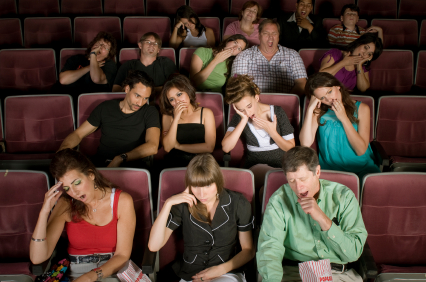
In a world where nearly all forms of entertainment are accessible by computer or smart phone it is easy to view the act of seeing a play as something not only inessential, but downright obsolete.  In one sense, I agree.  Why should you pay upwards of twelve bucks to see The Sound of Music (or A Midsummer Night’s Dream, for that matter) for the umpteenth time when Oscar’s 2011 Best Picture is still playing at the local movie theater for the same price?  

If we are discussing most theater as we know it today, in both experiences you will be sitting in a dark room and required to be mostly passive and silent.  Perhaps the show will be entertaining and you will feel a sense of camaraderie with others in the audience who are laughing along with you during the performance/movie, but when the lights go up, then what?  Maybe you’ll be able to applaud at the live show and talk to a few actors who will politely nod before moving on to their friends and family, but in both the live theater and movie theater scenario you will likely leave the building with a head full of thoughts and opinions and no where to put them.

Though I cannot speak for everyone, I would call this my “typical theater experience” as an audience member.  This is not to critique the quality of the writing or acting in the plays I’ve seen, because so many have been excellent, but I usually leave the theater with a slight feeling of emptiness.  Correct me if I’m wrong, but I don’t think I’m alone in this.

So why does the experience need improvement?

If we focus a little bit on the movie theater model, it’s easy to measure success.  Looking at content, the highest grossing film of all time is James Cameron’s Avatar.  The draw for repeat viewings of this film was the fact that the 3D experience was vastly superior in the theaters; so much so that the film was re-released a few months later for a second triumph at the box office.  Audiences raved about the special effects and gave credit to advances in filmmaking technology.  The film was not the stand-out in writing, acting or plot (different films took home the Oscars that year) but the experience of watching the film was revolutionarily innovative for the industry.

By comparing** financial success in the movie industry with theater, the point I’m trying to make is not that live theater needs to heavily invest in special effects but that much more importance needs to be placed on the audience experience.  When I say that the “typical theater experience” needs to be improved upon, I am speaking specifically to that sense of alienation and emptiness generated in audience members leaving the theater after a performance.

At the beginning of this blog I noted that the increase in access to entertainment (thanks to ever-advancing technology) may be making the need for live theater obsolete.  However, this technology only makes entertainment broadly accessible at the individual level.  In other words, I don’t see large groups of people getting together in one room to watch their favorite TV show on their individual iPads… yet.

What I do see (and participate in) are social meetings on a virtual plane.  Facebook is the greatest example of this kind of activity, where people log in to be social on their own time.  They may not have direct contact with their friends, but they leave messages that produce a similar (if not slightly more superficial) sense of socialization.  Diane Ragsdale notes in her article, Recreating Fine Arts Institutions that “Americans live in an increasingly free, time-shifting, do-it-yourself culture.  Fully half of all teens have created a blog or Web page, posted original artwork, photographs, stories or videos online, or remixed online content into their own creations.”  In these terms, our culture has never before had a stronger sense of creativity, yet little of it seems to be transferring to the audience experience at the local theaters.

Is it possible for theaters to harness the creativity of their audiences?  Can technology that is used to create virtual social spaces enhance the social experience of audience members who are together in a physical space?  By embracing what technology has facilitated in America as a culture of change, can theaters adapt their models to not only be more elastic but also allow for DIY participation from their audiences?

Yes.  Yes.  Yes.

I believe it is entirely possible for theaters to do all of these things.  The first step is simply allowing the public to participate in multiple levels of engagement at strategic points along the artistic process.  To illustrate what I mean, I will list examples and place them on something I call “the active engagement scale.”  

Ms. Ragsdale details one example:
“Four years ago, Chicago’s Steppenwolf Theatre launched First Look 101, in which they invite 101 patrons to join them at important steps of developing a new play.  Most arts organizations offer behind-the-scenes opportunities only for major donors.  First Look 101, however, is affordable ($45 for students and $75 for others) and open to anyone.  The three-month program gives people the chance to attend an unrehearsed table reading, the first day of rehearsal (including designer presentations), a rehearsal involving blocking an scene work, a technical rehearsal (when elements such as lights and sound are incorporated), and a final performance.”

This example is what I would designate to the lower end of the active engagement scale.  Though the program demystifies the artistic process and allows audiences to look at and listen to what the theater is doing in the stages before opening night, they are not asked to give feedback nor are they given opportunities to create.

Arena Stage also developed a “First Look” style program called “Theater 101” but added an important component.  They note on their site that “each event will be followed by a discussion moderated by Arena artistic staff.”  The discussion opportunity raises this program to the moderate level of engagement on the scale as audiences are given a chance to express their opinions and ideas.  Still, the creativity of the audience is left largely untapped.

Because so many opportunities for creative expression are available online, I think one of the easiest ways for audiences to reach the high end of the active engagement scale (where they are observing, reflecting, expressing AND creating) is to give them a voice on the theater organization’s website.  One example of this comes from On the Boards, who invited “members of their community” ---including audience members--- to publish their impressions about performances on the Blog the Boards section of the organization’s website.  Risky?  Possibly, though it appears blog posts were moderated to prevent any personal attacks.  Successful?  It appears so!  There was a large quantity of blogs (spanning several years) and those I clicked at random were insightful and well-written: a definite improvement on most fan forums I’ve seen in the past.


Another example of high active audience engagement would be performances that actually take audience volunteers to participate in the show.  Improvisational comedy (like that on Whose Line is it, Anyway?) is often reliant on audience suggestions and ideas to craft the performance.  Productions that follow the format of Augusto Boal’s Theatre of the Oppressed allow audience members to “pause” a performance and step into the action on stage in order to solve the problems created by the actors in the scene.  In both examples, audiences can voice their opinions and suggestions to directly affect the show and create new outcomes.

All of these examples are given to show that theaters are trying interesting and innovative techniques to engage their audiences at multiple levels of activity.  Perhaps these specific methods are not all appropriate for my local theaters, but they certainly help to get ideas flowing.

In a culture of change, it is important that the theater experience does not fall into the category of “typical.”  We are all far too creative for redundancy.

**Supplementary Explanation of Comparing For-Profit to Non-Profit Businesses:
Most live theater organizations are not for-profit businesses, so it is not always easy to draw accurate comparisons.  For a movie theater, the audience decides with their dollars about what appeals to them, but the measure of a non-profit’s success is a little more complex.   To begin, a non-profit, while allowed to make a profit (or more accurately, a “surplus”), cannot distribute that income to its members (the equivalent of this would be a corporation paying dividends to its share holders).  Those earnings must be retained by the organization for its self-preservation, expansion and future plans.

With this in mind, the first priority of a non-profit organization (by law) is to its mission.  Mission statements for non-profit theaters fall under the “Public Benefit Non-Profit Corporation” category, which is restricted to “businesses formed for scientific, charitable, literary, or educational purposes.”  The following is an example of a non-profit theater’s mission statement:

[City Name] Rep's mission is to stimulate, celebrate and enhance understanding of ourselves and others through the shared experience of live theatre by producing new plays and classics marked by innovative interpretations and a reflection and inclusion of our community and the world in which we live.

The key phrase in this statement is “enhance understanding” which relates to the “educational purpose” aspect of a non-profit mission statement.  If the theater achieves its mission through its operations, one could argue that it is a successful non-profit, even if it has lost money.  Of course, if the non-profit continues to lose money it will not be able to maintain the operations that achieve its mission, therefore a positive revenue stream can be a supplementary measure of the non-profit’s lasting success.

In contrast, the basic “mission” of a for-profit business is simply to make a profit.  The commonality is that not losing money helps both kinds of businesses, no matter where their priorities lie.