
With multiple social media sites, different events and content contributors, organizing and managing your social media campaigns can seem nightmarish. Using services like HootSuite, however, can empower you to organize your content to schedule postings at the perfect time of day for any day of the year. I've recently found out just how important good Social Timing happens to be.
Here is a great new infographic from KissMetrics on the science behind great social timing. On any given day, the best time to tweet is about 5pm ET, when about 6% of all re-tweets are made. According to the study, 1-2 tweets per hour seems optimal for click through, especially mid-week or on weekends, at noon or between 5 and 6pm. Meanwhile, Facebook is much more likely to drive shares and CTR on Saturday around lunchtime, so long as you don’t post more than once.
Cool New Tools With HootSuite Publisher
1. Scheduling Tweets With Calender View.
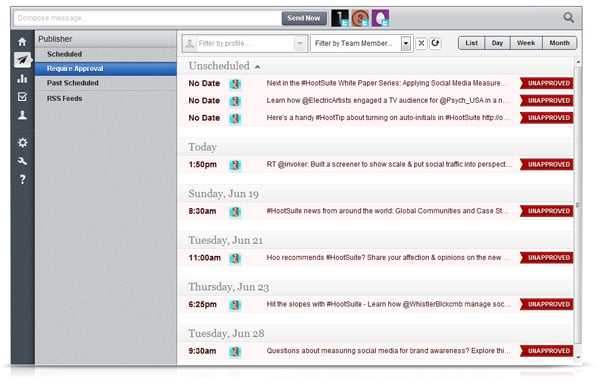
Since we may not have our schedules perfectly aligned to tweet or update our social networks at optimum times, HootSuite allows users to schedule their posts in advance. As of June 15th 2011, HootSuite has made scheduling even easier. Now you can slice and dice the destination profiles for each message and drag-and-drop your updates into time slots to match your editorial plans.

The whole power of daily/weekly/monthly calendar view (seen above) will soon only be available with Pro and Enterprise membership plans, but currently everyone can take the advanced scheduling functionality for a spin to see how calendar views can manage complex campaigns.
2. Limiting Permissions.
How I Used HootSuite to Conduct
a Successful Social Media Campaign for My Theater
1. The first step was for me to define the goals of the campaign: I wanted to see more engagement (likes and comments) on the Rocklin Shakespeare Facebook page while teaching my viewers fun facts about the Bard.
2. Next, I took that goal and turned it into a game, a trivia challenge, to be exact. I'd already written a great deal of Shakespeare Trivia Questions in preparation for another online game, so converting the questions into the proper format was easy.
3. I added an incentive for users to play by offering a prize. To get the ball rolling, I told users that it would take five "likes" on the post to uncover what that prize was, and launched into the game. Oddly, users didn't seem to care what the prize happened to be, they were excited enough to be playing for a prize that they dove right in. Eventually the status post got the five "likes" and I revealed three prize options: a Rocklin Shakespeare T-Shirt, a purse of ducats that was used as a prop in our production of The Taming of the Shrew, and the bragging rights of being featured with picture and bio on our Facebook hall of fame.
4. But users were already engaged. They didn't rush to unlock the prize, because liking that post wasn't worth any points. Here was the first trivia question (last names are obscured for privacy):

Points were awarded to the first AND second responses with the correct answers. This added a sense of urgency to the contest, and users rushed to be first and second. To make the race fair, I always informed the viewers when to look for the next update. This was easy to do, since I'd already scheduled the entire week-long contest in a few minutes on HootSuite.
5. At midnight, the answer was given along with an informative link about it. Five minutes later, a bonus question appeared to reward viewers for checking the site at the appointed time. The answer to the bonus question always featured in the informative link that came before it. In this way, users would quickly learn to check posted links and would be rewarded for doing so. Additionally, users got points for "liking" the bonus posts, which of course they did.

6. I took this formula and repeated, with one question, one link and one bonus question each day for a week. The final question was timed for noon on Saturday, which happens to be a peak time of the week for facebook sharing.
7. By analyzing the data on Facebook insights, saw that the contest increased the user interactions substantially. Weekly post views rose by 217% and feedback increased by a staggering 3400%. The campaign achieved its set goals.

The total cost of the contest was a T-Shirt (that I'd already had in overstock) and 99 cents in postage. Again, using HootSuite I was able to type up and schedule a week's worth of facebook page updates in minutes.
Other Helpful Links:
Did you learn something useful from this post? Click on the +1 button below so that others may find it when they search on Google.


