Showing posts with label Audience Engagement. Show all posts

Tuesday, June 28, 2011

Tweet to Conquer! Can the Little Bluebird be Your Secret Weapon?

Topics in this Post Include:
-3 Ways You Can Use Twitter to Drive People to Your Website
-Using Twitter to Promote Your Shows, Events or Products


3 Ways You Can Use Twitter to Drive People to Your Website:
1.    By composing fabulous tweet headlines that attract views. The headline is the only thing readers will see before making the decision to follow your link. If the headline is catchy, they'll pursue it, if it isn't, you've just lost a potential viewer.

2.    By linking those headlines to high quality content. Content should have your potential audience/customers in mind and reward them with something useful, like practical tips, exciting offers or special deals. If the content on our sites is truly remarkable, people will start tweeting about it on their own.

3.    By using the Twitter "Favorites" feature to list positive reviews from your fans. At the bottom of each tweet in your Twitter stream, there is a little star. When you click the little star, that tweet gets added to your Favorites Tab. When you track what people are saying about you using Twitter Search,* favorite all of the positive tweets. These 3rd party testimonies will be valuable to show the public what other people think of your work.
*To monitor yourself (or your theater company) on Twitter, use the Twitter Search Tool (http://search.twitter.com) to search and track what people are saying about your company, products, competitors, events, campaigns or any other hot words in the industry.  Be helpful: if you find in your search that someone is looking for a service you know where to find, respond to connect them with the right people.  Others will begin to do the same for you! 

Using Twitter to Promote Your Shows, Events or Products

Tweet-ups are a great way to get to know your Twitter community offline. The next time you hold an event, fundraiser or open house, tweet about it! The best practice is to send people directly to an event-sign-up page.
VolunTweet-ups are a variation of the above geared toward gathering volunteers for charitable events. The name is still pretty new, but it is already earning a positive reputation for philanthropy across social media. VolunTweet-ups are a great way to get your Twitter followers to support and spread your causes and, as an indirect result: yourself.
The Hashtag for individual events, products and promotions should be selected and agreed upon before your group starts tweeting about them. This will enable you to track the mentions of the specific event, product or promotion using Twitter Search, and will increase each hashtag's likelihood of becoming a Trending Topic.


Selecting a hashtag for an event is also beneficial because:
• During the event, people often use the hashtag while live-tweeting, or tweeting what they see/hear in real-time. The hashtag will aggregate the event tweets, building an online conversation around the event.
• People who are not at the event will see your hashtag and perhaps use it too. A popular #hashtag often sparks curiosity, and people will go to Twitter Search to follow the conversation around the event.
Finally, it doesn't hurt to take a look at best practices to see how others are using Twitter to succeed.  Here are some helpful links:

Did you learn something useful from this post?  Click on the +1 button below so that others may find it!

Friday, June 24, 2011

Tech Report: Could HootSuite Be Your Social Media Savior?

Excuse the belated Tech Tuesday---I've been building websites round the clock this week!


With multiple social media sites, different events and content contributors, organizing and managing your social media campaigns can seem nightmarish.  Using services like HootSuite, however, can empower you to organize your content to schedule postings at the perfect time of day for any day of the year.  I've recently found out just how important good Social Timing happens to be.
Here is a great new infographic from KissMetrics on the science behind great social timing. On any given day, the best time to tweet is about 5pm ET, when about 6% of all re-tweets are made.  According to the study, 1-2 tweets per hour seems optimal for click through, especially mid-week or on weekends, at noon or between 5 and 6pm.  Meanwhile, Facebook is much more likely to drive shares and CTR on Saturday around lunchtime, so long as you don’t post more than once. 

Cool New Tools With HootSuite Publisher
1. Scheduling Tweets With Calender View.  
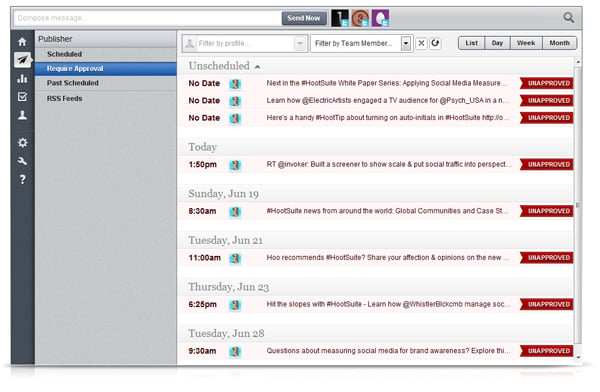
Since we may not have our schedules perfectly aligned to tweet or update our social networks at optimum times, HootSuite allows users to schedule their posts in advance.  As of June 15th 2011, HootSuite has made scheduling even easier.   Now you can slice and dice the destination profiles for each message and drag-and-drop your updates into time slots to match your editorial plans.
The whole power of daily/weekly/monthly calendar view (seen above) will soon only be available with Pro and Enterprise membership plans, but currently everyone can take the advanced scheduling functionality for a spin to see how calendar views can manage complex campaigns.
2. Limiting Permissions.
With this designation, collaborating interns, contractors and new recruits can share search streams and compose messages, but are limited from broadcasting directly to valuable company profiles. Instead, drafts are held for approval in the calendar view until a qualified Team Member pushes to the send queue. It’s ideal for ensuring accurate and appropriate updates.  Sadly, this is not a free tool, but if you plan on getting a lot of new blood to help you make content for your company's social media, it may be worth the investment.

How I Used HootSuite to Conduct 
a Successful Social Media Campaign for My Theater

1.  The first step was for me to define the goals of the campaign: I wanted to see more engagement (likes and comments) on the Rocklin Shakespeare Facebook page while teaching my viewers fun facts about the Bard.

2. Next, I took that goal and turned it into a game, a trivia challenge, to be exact.  I'd already written a great deal of Shakespeare Trivia Questions in preparation for another online game, so converting the questions into the proper format was easy.

3.  I added an incentive for users to play by offering a prize.  To get the ball rolling, I told users that it would take five "likes" on the post to uncover what that prize was, and launched into the game.  Oddly, users didn't seem to care what the prize happened to be, they were excited enough to be playing for a prize that they dove right in.  Eventually the status post got the five "likes" and I revealed three prize options: a Rocklin Shakespeare T-Shirt, a purse of ducats that was used as a prop in our production of The Taming of the Shrew, and the bragging rights of being featured with picture and bio on our Facebook hall of fame.

4.  But users were already engaged.  They didn't rush to unlock the prize, because liking that post wasn't worth any points.  Here was the first trivia question (last names are obscured for privacy):
Points were awarded to the first AND second responses with the correct answers.  This added a sense of urgency to the contest, and users rushed to be first and second.  To make the race fair, I always informed the viewers when to look for the next update.  This was easy to do, since I'd already scheduled the entire week-long contest in a few minutes on HootSuite.

5. At midnight, the answer was given along with an informative link about it.  Five minutes later, a bonus question appeared to reward viewers for checking the site at the appointed time.  The answer to the bonus question always featured in the informative link that came before it.  In this way, users would quickly learn to check posted links and would be rewarded for doing so.  Additionally, users got points for "liking" the bonus posts, which of course they did.

6.  I took this formula and repeated, with one question, one link and one bonus question each day for a week.  The final question was timed for noon on Saturday, which happens to be a peak time of the week for facebook sharing.

7. By analyzing the data on Facebook insights, saw that the contest increased the user interactions substantially.  Weekly post views rose by 217% and feedback increased by a staggering 3400%.  The campaign achieved its set goals.
The total cost of the contest was a T-Shirt (that I'd already had in overstock) and 99 cents in postage.  Again, using HootSuite I was able to type up and schedule a week's worth of facebook page updates in minutes.

Other Helpful Links:


Did you learn something useful from this post?  Click on the +1 button below so that others may find it when they search on Google.

Monday, June 20, 2011

Marketing Monday: Mobile Takeover! Expect SoLoMo Gamification to Explode.

Last Monday I wrote about the need for theaters (and others) to accept and utilize mobile marketing---even during shows/movies.  This week I have a few more numbers to back this claim.


According to a study published on Flurry this morning, the minutes U.S. consumers spend on their mobile apps has eclipsed the number of minutes they spend on the web, though both continue to rise.  Here's the chart:


Here's what Flurry reports U.S. mobile users are doing while they're on their mobile apps:


Gaming and social networking are, by far, the most common practices on Mobile Apps right now.


SoLoMo and the Rise of "Gamification"


SoLoMo stands for social, local and mobile.  The "gamification" of apps is a surefire way to engage a new generation of audiences, and by adding a gaming layer to social-local-mobile interaction, marketers are creating ways to get the biggest piece of the mobile pie.  


With geolocation applications and services like Foursquare, Gowalla, Loopt and BrightKite, as well as virtual check-ins on Twitter, Facebook and beyond, the convergence of SoLoMo is creating a whole new way to market.  These applications are social first, gaming second.  But what about apps that reverse the equation?


SCVNGR is location-based gaming first, social second.  While you can easily connect the game to social platforms like Facebook and Twitter, SCVNGR makes check-ins a mere gateway to a set of games and challenges designed for specific locations.


Take a look at a set of challenges for American Apparel:


The check-in is worth +1 point, while the main challenge (taking a picture of yourself posing like a mannequin) is worth +5.  The social aspects, such as sharing the picture or sharing the useful note you wrote about the store for the +2 points, are secondary.

The app is young, however, and has run into problems with implementation and follow-through.  It seems that if you wish to create a successful experience on SCVNGR, you have to do it yourself.


Here's a link on how to start a marketing campaign on SCVNGR.


 Geocaching, however, is also a game first, social second type of application.  It has been around a long time (11 years!) and is already active on all seven continents.  By putting a Geocache at the site of your business, you put yourself on their map for users to find.


Existing cache types allow for a game play, including:

  • Mystery/puzzle: This cache requires one to discover information or solve a puzzle to find the cache. Some mystery caches provide a false set of coordinates with a puzzle that must be solved to determine the final cache location. In other cases, the given location is accurate, but the name of the location or other features are themselves a puzzle leading to the final cache. Alternatively, additional information is necessary to complete the find, such as a padlock combination to access the cache.
  • Multi-cache: This variation consists of multiple discoveries of one or more intermediate points containing the coordinates for the next stage; the final stage contains the log book and trade items.
  • Event Cache: This is a gathering organized and attended by geocachers. Physical caches placed at events are often active only for the event date.

Idea for Adding a Game Layer to Traditional or Existing Caches:

  • QR or Scannable Codes.  Include these as a sticker on the inside or outside of your geocache.  When the code is scanned, users are linked to your website with your personal game challenges.  You can also link straight to a game located on the web.
GPS services aside, I'm still going to herald the potential of QR Codes, especially for entertainment events.  What if you're the lucky patron at a show (movie, theater, concert or other) with a QR code under your seat that gets you a free drink at the snack bar?  Or an upgrade to a backstage pass?  The basis for all of these social gaming platforms is the possibility of earning a reward, be it virtual (like 4square mayorship) or in real life.

Things to think about.

PS.  Since my brother designs mobile apps, you may be see the Theater Friendly App available in the near future.