For a lot of people and businesses, summer is a slower season. Not only are customers on vacation, but staff members are as well. So how do you keep your social media pages flush with great content when there just isn't much going on around the office?
Simple: curate.
The internet is not lacking in content: 48 hours of video are uploaded to YouTube every minute, Facebook boasts close to one billion pieces of content shared on its site each day, and Twitter users are generating 200 million tweets per day. In all of that content, you can use your expertise to find posts, videos, pictures and articles that are relevant to your topics of influence and your fans interests.
Personal Example: My Shakespearean theater company is not working on a show right now, but that doesn't mean our Facebook fans are tired of watching great Shakespearean performances. So, since I don't have any content to generate at present, I'm featuring clips from some of the greatest Shakespearean performances recorded. As a former Theater and Performances Studies major with a minor focus on Shakespeare (through the English department) I've had the good fortune to be exposed to a lot of great performances and learn which were legendary in their time. By finding YouTube clips of these performances and providing a little background, I've successfully curated great content and added value to my Shakespeare company's Facebook page.
Twitter is where I see the most curating activity at present, and it's very useful! Often I decide on whether to follow a Twitter user based on the usefulness of their posts. Whether or not they've written the posts themselves is not always a problem as long as they are truly good curators. I do try to find the best content generators to follow as well, but they're all the more welcome and credible if they're fantastic curators.
In the end, the people who provide the most relevant and useful information to their fans tend to succeed. If that means the content you share is curated from time to time, don't fret: you're still creating value for your fans.
-Dani Loebs
P.S. If you're nervous about how many pieces of content to post, the Science of Social Timing from Kissmetrics is a great guide. Just click on the infographic to enlarge after you follow the link.
Showing posts with label Marketing. Show all posts
Tuesday, August 2, 2011
Tuesday, June 28, 2011
Tweet to Conquer! Can the Little Bluebird be Your Secret Weapon?
Topics in this Post Include:
-3 Ways You Can Use Twitter to Drive People to Your Website
-Using Twitter to Promote Your Shows, Events or Products
3 Ways You Can Use Twitter to Drive People to Your Website:
1. By composing fabulous tweet headlines that attract views. The headline is the only thing readers will see before making the decision to follow your link. If the headline is catchy, they'll pursue it, if it isn't, you've just lost a potential viewer.
2. By linking those headlines to high quality content. Content should have your potential audience/customers in mind and reward them with something useful, like practical tips, exciting offers or special deals. If the content on our sites is truly remarkable, people will start tweeting about it on their own.
3. By using the Twitter "Favorites" feature to list positive reviews from your fans. At the bottom of each tweet in your Twitter stream, there is a little star. When you click the little star, that tweet gets added to your Favorites Tab. When you track what people are saying about you using Twitter Search,* favorite all of the positive tweets. These 3rd party testimonies will be valuable to show the public what other people think of your work.
*To monitor yourself (or your theater company) on Twitter, use the Twitter Search Tool (http://search.twitter.com) to search and track what people are saying about your company, products, competitors, events, campaigns or any other hot words in the industry. Be helpful: if you find in your search that someone is looking for a service you know where to find, respond to connect them with the right people. Others will begin to do the same for you!
Using Twitter to Promote Your Shows, Events or Products
Tweet-ups are a great way to get to know your Twitter community offline. The next time you hold an event, fundraiser or open house, tweet about it! The best practice is to send people directly to an event-sign-up page.
VolunTweet-ups are a variation of the above geared toward gathering volunteers for charitable events. The name is still pretty new, but it is already earning a positive reputation for philanthropy across social media. VolunTweet-ups are a great way to get your Twitter followers to support and spread your causes and, as an indirect result: yourself.
The Hashtag for individual events, products and promotions should be selected and agreed upon before your group starts tweeting about them. This will enable you to track the mentions of the specific event, product or promotion using Twitter Search, and will increase each hashtag's likelihood of becoming a Trending Topic.
Selecting a hashtag for an event is also beneficial because:
• During the event, people often use the hashtag while live-tweeting, or tweeting what they see/hear in real-time. The hashtag will aggregate the event tweets, building an online conversation around the event.
• People who are not at the event will see your hashtag and perhaps use it too. A popular #hashtag often sparks curiosity, and people will go to Twitter Search to follow the conversation around the event.
Did you learn something useful from this post? Click on the +1 button below so that others may find it!
Labels:
Audience Engagement,
Marketing,
Theater Marketing,
Twitter
Monday, June 20, 2011
Marketing Monday: Mobile Takeover! Expect SoLoMo Gamification to Explode.
Last Monday I wrote about the need for theaters (and others) to accept and utilize mobile marketing---even during shows/movies. This week I have a few more numbers to back this claim.
According to a study published on Flurry this morning, the minutes U.S. consumers spend on their mobile apps has eclipsed the number of minutes they spend on the web, though both continue to rise. Here's the chart:
Here's what Flurry reports U.S. mobile users are doing while they're on their mobile apps:
Gaming and social networking are, by far, the most common practices on Mobile Apps right now.
SoLoMo and the Rise of "Gamification"
SoLoMo stands for social, local and mobile. The "gamification" of apps is a surefire way to engage a new generation of audiences, and by adding a gaming layer to social-local-mobile interaction, marketers are creating ways to get the biggest piece of the mobile pie.
With geolocation applications and services like Foursquare, Gowalla, Loopt and BrightKite, as well as virtual check-ins on Twitter, Facebook and beyond, the convergence of SoLoMo is creating a whole new way to market. These applications are social first, gaming second. But what about apps that reverse the equation?
SCVNGR is location-based gaming first, social second. While you can easily connect the game to social platforms like Facebook and Twitter, SCVNGR makes check-ins a mere gateway to a set of games and challenges designed for specific locations.
Take a look at a set of challenges for American Apparel:
The check-in is worth +1 point, while the main challenge (taking a picture of yourself posing like a mannequin) is worth +5. The social aspects, such as sharing the picture or sharing the useful note you wrote about the store for the +2 points, are secondary.
The app is young, however, and has run into problems with implementation and follow-through. It seems that if you wish to create a successful experience on SCVNGR, you have to do it yourself.
Here's a link on how to start a marketing campaign on SCVNGR.
Geocaching, however, is also a game first, social second type of application. It has been around a long time (11 years!) and is already active on all seven continents. By putting a Geocache at the site of your business, you put yourself on their map for users to find.
Existing cache types allow for a game play, including:
Idea for Adding a Game Layer to Traditional or Existing Caches:
According to a study published on Flurry this morning, the minutes U.S. consumers spend on their mobile apps has eclipsed the number of minutes they spend on the web, though both continue to rise. Here's the chart:
Here's what Flurry reports U.S. mobile users are doing while they're on their mobile apps:
Gaming and social networking are, by far, the most common practices on Mobile Apps right now.
SoLoMo and the Rise of "Gamification"
SoLoMo stands for social, local and mobile. The "gamification" of apps is a surefire way to engage a new generation of audiences, and by adding a gaming layer to social-local-mobile interaction, marketers are creating ways to get the biggest piece of the mobile pie.
With geolocation applications and services like Foursquare, Gowalla, Loopt and BrightKite, as well as virtual check-ins on Twitter, Facebook and beyond, the convergence of SoLoMo is creating a whole new way to market. These applications are social first, gaming second. But what about apps that reverse the equation?
SCVNGR is location-based gaming first, social second. While you can easily connect the game to social platforms like Facebook and Twitter, SCVNGR makes check-ins a mere gateway to a set of games and challenges designed for specific locations.
Take a look at a set of challenges for American Apparel:
The check-in is worth +1 point, while the main challenge (taking a picture of yourself posing like a mannequin) is worth +5. The social aspects, such as sharing the picture or sharing the useful note you wrote about the store for the +2 points, are secondary.
The app is young, however, and has run into problems with implementation and follow-through. It seems that if you wish to create a successful experience on SCVNGR, you have to do it yourself.
Here's a link on how to start a marketing campaign on SCVNGR.
Geocaching, however, is also a game first, social second type of application. It has been around a long time (11 years!) and is already active on all seven continents. By putting a Geocache at the site of your business, you put yourself on their map for users to find.
Existing cache types allow for a game play, including:
- Mystery/puzzle: This cache requires one to discover information or solve a puzzle to find the cache. Some mystery caches provide a false set of coordinates with a puzzle that must be solved to determine the final cache location. In other cases, the given location is accurate, but the name of the location or other features are themselves a puzzle leading to the final cache. Alternatively, additional information is necessary to complete the find, such as a padlock combination to access the cache.
- Multi-cache: This variation consists of multiple discoveries of one or more intermediate points containing the coordinates for the next stage; the final stage contains the log book and trade items.
- Event Cache: This is a gathering organized and attended by geocachers. Physical caches placed at events are often active only for the event date.
Idea for Adding a Game Layer to Traditional or Existing Caches:
- QR or Scannable Codes. Include these as a sticker on the inside or outside of your geocache. When the code is scanned, users are linked to your website with your personal game challenges. You can also link straight to a game located on the web.
GPS services aside, I'm still going to herald the potential of QR Codes, especially for entertainment events. What if you're the lucky patron at a show (movie, theater, concert or other) with a QR code under your seat that gets you a free drink at the snack bar? Or an upgrade to a backstage pass? The basis for all of these social gaming platforms is the possibility of earning a reward, be it virtual (like 4square mayorship) or in real life.
Things to think about.
PS. Since my brother designs mobile apps, you may be see the Theater Friendly App available in the near future.
Labels:
Audience Engagement,
Gamification,
Marketing,
Mobile,
SoLoMo,
Technology
Sunday, June 12, 2011
Marketing Monday: Why Theaters Should Tell Patrons to Turn ON Their Phones
You arrive at the theater to watch a play. The House Manager (or whomever fills the function) approaches the stage (or loudspeaker) and welcomes the crowd.
"Ladies and Gentlemen," they say, "thank you for joining us at [name of theater company] for [name of play]. At this time, I would like you to take out your cell phones and turn them on."
Now wouldn't that be surprising?
Here are a few things I would love for the House Manager to say next:
- "Now send a text saying: fan [your page name] to 32665 or FBOOK to like us on Facebook."
- "Now text 40404 with the message: follow [your username] to follow us on Twitter."
- "Please turn on our Theater Friendly Phone Application while texting about the show in progress!"
First, I really don't understand why I have not seen this done. Obviously the people coming into the theater like your organization enough to shell out for tickets, so capturing dozens (even hundreds) of new "likes" and followers each night should be easy!
But wait, what was that last bullet point?
New Idea: The Theater Friendly Phone App
This post was actually inspired by a story I read about a movie theater. Apparently a patron became disgruntled when she was asked to turn off her cell phone during a movie and management had her thrown out. The woman's indignation at the turn of events was recorded in a (probably) drunken phone call to the theater. The theater's response with the ex-patron's inebriated rantings was to add captions and turn the recording into a YouTube video.
While I appreciate a good laugh, and want to smile at their creativity, I feel they're missing a big point:
People don't like to turn off their cell phones.
Even I feel apprehensive when I am unreachable for over two hours. What if something happened to a family member? Don't forget that many of those patrons hired a baby sitter and probably want to be contacted in case of an emergency. So why not take on a huge chance to increase audience engagement for your theater by being the first to allow cell phone usage during a show or movie? I think it's a great idea, considering that I've also mentioned some astonishing statistics from Google about how addicted Americans are to their phones.
For Review:
- 72% use their phones while "consuming other media." A third of that use is while watching TV.
- 39% use their phones while they're in the bathroom .
- 20% would rather give up their cable TV before giving up their phones.
I want to see an app that:
- Is included with the purchase of a show/movie ticket (either as a free download with online purchase or as a QR Code on the physical ticket).
- Will dim the screen and mute all sounds on the phone to prevent any obstructions in visibility or audibility for other audience members.
- Blocks video recording (though how one would be able to sell a bootleg movie or show from a cell phone is beyond me).
- Prompts the user to "like" the theater on Facebook and follow it on Twitter.
- Logs ticket purchases and suggests new releases based on the user's preferences (like Netflix and more).
- Allows the user to tweet/update their Facebook about the experience at the theater and rate the movie or show.
Will this cause spoilers? Not any more than usual. I see most patrons getting on their phones as soon as they leave the theater anyway. Why not let them talk about you for the two hours they're enjoying your service?
I'm probably going to be giving my code master a call... but in case he's busy: somebody should be doing this!
Controversially Yours,
Photo courtesy of unreality.com.
Labels:
Facebook,
Innovation,
Marketing,
Mobile,
New Rules,
Theater Marketing,
Twitter
Tuesday, May 24, 2011
Google Social Search or How I learned to Stop Worrying and Love SEO
| He's excited about SEO. Image courtesy of makefive.com |
What is it, you ask? Why, SEO of course!
SEO stands for Search Engine Optimization. Basically, SEO is the method you use to get your website to appear at or near the top of the page when people search for you (or when they search for things that describe you, like "entertainment near <your city>"). While you can certainly hire an SEO expert to help you with boosting your website to the top of the search rankings, here are a few basic tips I've picked up to help get you started.
7 SEO Tips for Your Theater Website:
- First and foremost: decide the content of your site based on what is best and most relevant for your audience. Ultimately, you're going to be found by the right people if you are providing the content they're looking for. A theater company's website may not be found very easily by potential audience members if they only refer to themselves as a "performance collective," for example.
- Do try to include words and phrases in the content of your website that you think potential audience members will use to describe you in a search. Make a short list of phrases you would use to find a theater like yours and then ask your coworkers, friends and family to do the same. If you see big similarities in these lists, you'll have found some great key words and phrases to include on your website.
- Just make sure you try to get 2 or 3 of those key words on the home page of your site. This will help the search engine direct users to the correct starting page. To gauge success of these keywords, keep an eye on your site ranking in search results and see if there is movement.
- Write a page or blog post on your site that’s dedicated to each of your top keywords. This is also a good way to show your customers you know all about the specific product or service in which they are interested. Picture yourself explaining to a friend or relative in five minutes what you do in that specific area. The write up need not be more than 200–300 words and should list the target keywords no more than two or three times. Remember this should be as natural and easy to read as possible, but have the keywords mentioned in a way that makes sense.
- Post links to your site (or relevant updated pages) on your social networks. Link it to your theater's twitter feed and facebook page. Some of what helps a site earn a high search ranking has to do with the amount of traffic the site is generating. At the very least, it will be easier for friends to share with one another.
- Ask your friends and colleagues to post something about your theater company on their website, and return the favor. Ideally, when they mention your theater's name, they can highlight it as a link back to your main website. When done in a relevant way that provides value to the reader, this sort of link exchange makes good business partnerships and helps boost both sites. Consider yourself an amateur concierge helping fans of your work reach something else they might like (much like Amazon.com does with purchases).
- Also, search engines tend to favor sites with more external links pointing to them from a variety of sources over websites with few back links (if any). In other words: search engines view relevant links to a website as a vote of confidence.
Google Social Search: Social Networks to the Rescue!
Maybe you just can't seem to crack the right keywords to get your site out front and center. After all, nearly every theater company's website has the words "theater," "theatre" (which is the British spelling that Americans still seem to love), or "play." If you get TOO specific, your audience won't know how to find you.
Don't worry, your friends and colleagues will now be able to help in an even bigger way. A darling video from Google explains how:
Though Social Search was launched in 2009, the new updates have an effect on webpage rankings. Like the video explains, if a friend of yours has linked to your page, Social Search will move that page up in rankings since the search engine will deem the page more relevant to you. The more people in your local network who recommend or link to your page, the more likely potential audience members for your theater (aka locals) will find you when they search.
So as all these tips seem to sum up, know your fans and treat them well. Good deeds on the internet are usually rewarded.
Labels:
Google,
Marketing,
Search Engine Optimization,
SEO,
Social Media,
Social Networks
Monday, May 23, 2011
Fun and Games with Mobile Marketing (for your Theater)
| Photo courtesy of digitaltrends.com |
- First, when the Chairman of the National Endowment of the Arts says that the problem with theater non-profits in America is that there is an over-supply of theaters and not enough audience demand while data shows that the majority (51%) of the NEA's support in the form of grant money goes to only three out of fifty states (and nearly 35% of all NEA grant money is going exclusively to New York, Chicago and LA), there are some problems with representation in the theater funding world. We need all the advantages we can get.
- Second, theaters are having trouble adapting to the culture change brought on by newer generations who are exposed to less arts education and generally are not suited to the traditionally passive activity of attending live theater. While many theaters ARE adapting to cultural shifts and are managing to do it outside of NY, Chicago and LA, they're not marketing themselves well enough to get the word out about their fabulous innovations.
- Finally, much of this marketing information (with respect to social networks and mobile ads) is so new that NO ONE is an expert. This makes learning and writing about these marketing strategies fresh and fun!
This data was released by Google at the end of a colorful video only a few weeks ago:
“71% of us search because we saw an ad both on traditional media (43% search after seeing a TV ad) and on our phones (17% search after seeing an ad on a mobile device). And we’re acting: 9 out of 10 mobile users have taken action all thanks to a smart phone search. The simple fact is: Mobile Ads work.
Recall seeing a mobile ad? You’re not alone: 82% of users notice mobile ads yet 79% of top advertisers don’t have a mobile optimized website. It’s important to build a good mobile user experience because if we see a mobile ad we tend to click on the ad (42%), visit the advertiser’s site (35%), make a purchase (49%), or call the business (27%). Don’t miss the mobile movement; mobilize your marketing to reach the new Smartphone consumer.”
Is this relevant to your theater? Certainly, because Google also released that a huge percentage of users (95%) are searching for local businesses to meet their needs and 49% of local searches done by users are looking for entertainment. They could be searching for you; are you putting yourself out there? If so, is your website's mobile experience pleasant for the user (meaning, do you have a mobile optimized website)?
In the same report, Google discusses how inseparable Smartphone users are from their mobile devices, including the fact that
- 93% use their phones at home (where their laptops and desktops are accessible).
- 72% use their phones while "consuming other media." A third of that use is while watching TV.
- 39% use their phones while they're in the bathroom .
- 20% would rather give up their cable TV before giving up their phones.
With this in mind, it may be more of a sacrifice for audiences than you think when you ask patrons to turn off their cell phones before a performance. What I propose is that theaters begin to embrace the mobile habits of their audience.
Fun and Games for the Smartphone Crowd
| Louis Vitton QR Code created by Takashi Murakami for SET. Courtesy Engadget.com |
Pimp Your QR Codes
- I love QR Codes, those magical barcodes that can be scanned by a smartphone to launch an offline-to-online experience. Now there is technology to personalize QR codes to include colors, pictures, even your logo. Use it. Be artsy with it. More people will scan your codes and reach your website.
Wait, how am I using QR Codes?
- I'm glad you asked, because the possibilities are numerous. I've been using them for years to create scavenger hunts for my friends and family (looks like others have finally started following suit). If anyone wants the birthday present I got them, they have to scan the QR codes I've placed around the house, neighborhood or city and crack the riddles that appear when scanned. Each riddle leads to the next QR Code location which ultimately leads the player to their birthday gift. Obviously too many codes can make the game tiresome, so you should balance having enough clues to make the game worth playing, but not so many that they want to quit. I stick with 9-12.
- Maybe it's because I watched Legends of the Hidden Temple too much as a kid, but I also set up obstacle courses and games which ultimately reward the user with a QR Code. Also, users can earn special items (like my old baseball bat) to help them with the next challenge (breaking the piƱata to find the QR Code hidden within).
- To get back to the point, QR Codes can link users from everything to text, pictures, music, youtube videos, your website... whatever you can think of. You could put codes on the part of the theater ticket that the audience member will keep, in your programs, on refreshments (McDonald's monopoly taken to the next level?) or set up your own pre-show events with QR Code style fun and games that are on theme with your performance. This would be great for murder mysteries, for example.
- Just remember: a QR is kind of like a scratcher card, it takes a bit of effort to uncover, so there should be a payoff!
By the way, there are Smartphone applications in existence to help you design and customize your own QR Codes, but I haven't tested them. Other people have written how-to blogs for a DIY technique using a Photoshop-styled picture editor and trial and error. The possibilities are Googlable!
Friday, May 20, 2011
Identifying and Creating True Fans (to Market Your Theater)
I’m going to try to keep up with my bullet point format on this one, but first, a little bit of background.
The concept of true fans is not new. One of the most prominently blogged about opinions for what defines a “true fan” comes from Kevin Kelly, who suggests that individual artists need only maintain 1,000 true fans in order to make a living. Kelly writes:
| Example of a True Fan of Rubik's Cubes courtesy of Hardware Sphere |
“A True Fan is defined as someone who will purchase anything and everything you produce. They will drive 200 miles to see you sing. They will buy the super deluxe re-issued hi-res box set of your stuff even though they have the low-res version. They have a Google Alert set for your name. They bookmark the eBay page where your out-of-print editions show up. They come to your openings. They have you sign their copies. They buy the t-shirt, and the mug, and the hat. They can't wait till you issue your next work. They are true fans.”
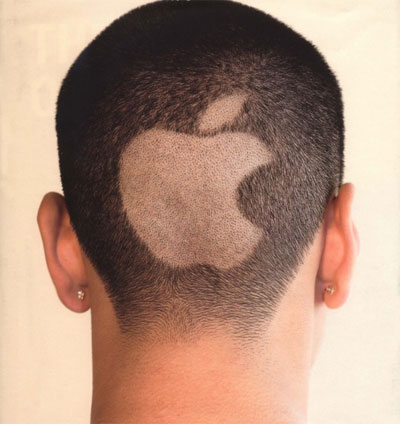
| An Apple True Fan. Courtesy internetevolution.com |
The math is simple, if a True Fan will spend $100/year on your work, and you net 1,000 true fans, an income of $100,000 per year will certainly allow you to live comfortably off of your art. Sadly, the math is actually a little TOO simple. I recommend that artists who consider this route for success read Kelly’s follow-up post, The Reality of Depending on True Fans, which crunches real numbers from a prolific musician who has used this strategy. The short answer is that you may need more than 1,000 true fans if you aren’t making enough high-valued art to get $100 out of them each year.
But the original point of this post was about identifying and creating true fans to help you market your theater, so let us take a look at the strategies from the world’s best marketed brand: Apple. Bullet points commence!
Applying Apple’s Strategies to Identify and Create True Fans
Apple Strategy 1: Don’t Sell Products. People buy what other people have. Sell membership.
- Remember in the last blog entry where I was bemoaning vague facebook posts that repeat the same, “come see our show” every few months? Stop focusing on selling tickets. If I never again see the term “butts in seats” in a blog about increasing audience, it will be too soon.
- Instead, focus on what people do at your shows. Theater is an experience-based art form that is best shared with other artistically-engaged people. Help people feel that their ticket buys them access to a very special experience with an exclusive group of like-minded people.
- Follow through with that promise. MAKE your shows a very special experience and allow opportunities for your audience to be a part of your theater’s unique artistic culture. Accompany shows with mixers, VIP events and use online social networks to foster and participate in conversations between your fans.
- If you run a volunteer theater company like me, the early adopters are the volunteers themselves. No one is investing more than your volunteers, and since they have already chosen to invest in your theater, they’re going to be eager to help you win (since a win for your theater is a win for them).
- If you don’t run a volunteer theater company, certainly don’t discount the potential your actors, crew and staff have as potential early adopters to help you win. Similar to volunteers, these individuals are still investing a great deal in your success and will take every opportunity to promote your brand to their friends and families.
- Those first fans/early adopters (employees, volunteers, your friends and families) want to help you promote, so make it easy on them. Give away stickers of your logo with every product/ticket you sell. Sell T-Shirts from your website so owners can proudly display your brand and endorse it.
- Make part of your website embeddable and make it easy to cut and paste your HTML code anywhere. This way fans will be able to associate themselves with you on their blogs, social networks and personal web pages. Make your embedded stickers, badges or feeds look stylish and keep them subtle so they don’t clash with the designs of your fans' websites.
- Reward early adopters by giving them exclusive offers. A great example of this is when Alicia Keys offered her new album a full week in advance to people who became fans of her facebook page. Can you give sneak previews to your early adopters and true fans? What else can you give them?
- Marketing isn’t what you do to reach your first customers; it’s what you do to help your first customers reach the rest. Marketing success is achieved when prospects easily repeat your message to others.
- Take a look at my post Theater and the Big Why to identify your theater’s message. Truth spreads faster than empty-but-shiny-sounding slogans.
- However, do try to keep messages brief. People can’t memorize more than a sentence or two unless you’re setting it to music and rhyme.
- If you are trying to create true fans, start with the all-important first impression and make their first experience memorable. To quote Apple Marketing guru, Steve Chazin, “Start with packaging. The relationship with the customer really starts after they buy from you.”
- To repeat from strategy #1, "help people feel that their ticket buys them access to a very special experience with an exclusive group of like-minded people.” How can you do this by sending special advanced tickets to people who buy ahead of time? Will you include a sticker? Spend a little more on the postage by including some exclusive publicity photos of your show in rehearsal? Add a special mobile tag that can be scanned to reveal a secret YouTube video with a thank you from the cast?
- Be creative in marketing to your fans, treat them with respect and communicate how much they are valued in every interaction you have with them. Remember, you are counting on your fans to help spread the word – and they need positive experiences to share.
Apple Strategies adapted from Steve Chazin’s ebook Marketing Apple, available on www.MarketingApple.com
Labels:
Active Engagement,
Marketing,
Social Media,
Social Networks,
True Fans
Thursday, May 19, 2011
Theater Marketing Using 3 Social Networks: Proudly Presented in Bullet Points!
Hey there! Dramatic Dissemination is back with more big Idea Blogs. Today's topic covers ways to use three social networking sites to market your theater. Off we go!
Facebook
- You have to create a page for your theater on facebook. With over 500 million users, the website’s population is larger than every country except for India and China. If you want to be seen, you have to be there.
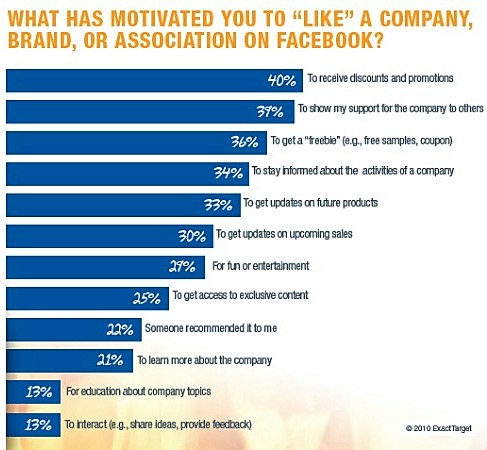
- However, when you make your page, keep in mind that the number one reason (at 40%) facebook users “like” pages is for the purpose of obtaining exclusive promotions and discounts. You have to give away a little on your facebook page to earn loyalty from your fans. See the graph below for more reasons people will “like” you.
- Work to create true fans. This means building a relationship with your fan base that allows them to identify with your brand. Do not use your page for the sole purpose of impersonal updates like “come to our next show!” or “great job everybody!” Use your status updates to engage in a conversation with your fans, respectfully discuss their feedback and build a sense of identity between your fans and the culture of your theater.
- Set up a store on your facebook page. True fans want every chance they can get to show that they are a part of your theater. Use that loyalty to promote your brand and bring more like minds into the fold. Facebook stores typically secure 1-10% of a business’ fan base. For a little perspective: in the 4th quarter of 2010, online sales were a record breaking $43.4 billion, +11% versus one year ago, according to comScore.
Twitter
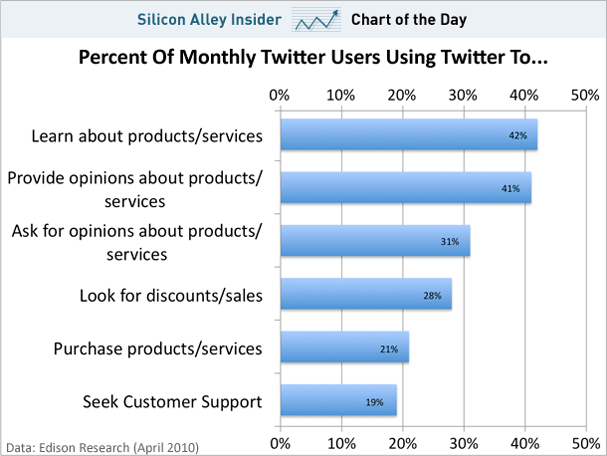
- Over 40% of the time that people are on Twitter, they are learning about products and services or providing opinions about brands. If you aren’t on Twitter, they won’t be tweeting about you.
- Shocker: People actually spend a little over 20% of their time on Twitter BUYING products or services. Again, if you aren’t on Twitter, the tweeters aren’t spending that purchasing power on you. You’re missing out on ticket sales. For other interesting ways that people are spending their time on Twitter, check the graph below.
- YouTube is the second largest search engine in the world. Do you have a product or service that can be featured in front of a camera? If you’re a theater, I have a feeling you do. Get a YouTube channel for your theater, but read the Terms of Service agreement so that you understand what can happen to your content.
- Content ownership technically belongs to the users, but YouTube's Terms of Service allows YouTube the licensing rights to use your content as they please until you delete it from the site. So rather than uploading complete performance recordings that you are trying to sell, give samples and trailers. Use Youtube for informational webcasts, behind-the-scenes bonuses, interviews with the artists and teasers for upcoming events. Feature highlights from VIP parties for those valuable loyal fans and allow fans to upload their own footage from these events.
- Always link these videos back to your main website, where you can feature/sell/rent your exclusive content.
- BONUS: A great idea that has yet to be used by a theater (at least to my knowledge) is a play, scene or passage done in the style of Virtual Choir. I’ve certainly toyed with the idea of using this technique to produce an online version of Hamlet… or use it for an original play!
There are certainly more social networks to cover, but I’ve decided to keep my posts briefer in order to get them posted more frequently. Speaking of social networks, why not connect with me on LinkedIn if you’d like to continue the conversation? http://www.linkedin.com/in/danielleloebs
(Graph of “What has motivated you to “like” a company, brand or association on facebook?” courtesy of ExactTarget. Chart of “Percent of Monthly Twitter Users Using Twitter To…” courtesy of Silicon Alley Insider from data collected by Edison Research.)
Labels:
Facebook,
Google,
Marketing,
Technology,
Theater Marketing,
Twitter,
YouTube
Subscribe to:
Posts (Atom)