Showing posts with label Theater Marketing. Show all posts

Tuesday, June 28, 2011

Tweet to Conquer! Can the Little Bluebird be Your Secret Weapon?

Topics in this Post Include:
-3 Ways You Can Use Twitter to Drive People to Your Website
-Using Twitter to Promote Your Shows, Events or Products


3 Ways You Can Use Twitter to Drive People to Your Website:
1.    By composing fabulous tweet headlines that attract views. The headline is the only thing readers will see before making the decision to follow your link. If the headline is catchy, they'll pursue it, if it isn't, you've just lost a potential viewer.

2.    By linking those headlines to high quality content. Content should have your potential audience/customers in mind and reward them with something useful, like practical tips, exciting offers or special deals. If the content on our sites is truly remarkable, people will start tweeting about it on their own.

3.    By using the Twitter "Favorites" feature to list positive reviews from your fans. At the bottom of each tweet in your Twitter stream, there is a little star. When you click the little star, that tweet gets added to your Favorites Tab. When you track what people are saying about you using Twitter Search,* favorite all of the positive tweets. These 3rd party testimonies will be valuable to show the public what other people think of your work.
*To monitor yourself (or your theater company) on Twitter, use the Twitter Search Tool (http://search.twitter.com) to search and track what people are saying about your company, products, competitors, events, campaigns or any other hot words in the industry.  Be helpful: if you find in your search that someone is looking for a service you know where to find, respond to connect them with the right people.  Others will begin to do the same for you! 

Using Twitter to Promote Your Shows, Events or Products

Tweet-ups are a great way to get to know your Twitter community offline. The next time you hold an event, fundraiser or open house, tweet about it! The best practice is to send people directly to an event-sign-up page.
VolunTweet-ups are a variation of the above geared toward gathering volunteers for charitable events. The name is still pretty new, but it is already earning a positive reputation for philanthropy across social media. VolunTweet-ups are a great way to get your Twitter followers to support and spread your causes and, as an indirect result: yourself.
The Hashtag for individual events, products and promotions should be selected and agreed upon before your group starts tweeting about them. This will enable you to track the mentions of the specific event, product or promotion using Twitter Search, and will increase each hashtag's likelihood of becoming a Trending Topic.


Selecting a hashtag for an event is also beneficial because:
• During the event, people often use the hashtag while live-tweeting, or tweeting what they see/hear in real-time. The hashtag will aggregate the event tweets, building an online conversation around the event.
• People who are not at the event will see your hashtag and perhaps use it too. A popular #hashtag often sparks curiosity, and people will go to Twitter Search to follow the conversation around the event.
Finally, it doesn't hurt to take a look at best practices to see how others are using Twitter to succeed.  Here are some helpful links:

Did you learn something useful from this post?  Click on the +1 button below so that others may find it!

Friday, June 24, 2011

Tech Report: Could HootSuite Be Your Social Media Savior?

Excuse the belated Tech Tuesday---I've been building websites round the clock this week!


With multiple social media sites, different events and content contributors, organizing and managing your social media campaigns can seem nightmarish.  Using services like HootSuite, however, can empower you to organize your content to schedule postings at the perfect time of day for any day of the year.  I've recently found out just how important good Social Timing happens to be.
Here is a great new infographic from KissMetrics on the science behind great social timing. On any given day, the best time to tweet is about 5pm ET, when about 6% of all re-tweets are made.  According to the study, 1-2 tweets per hour seems optimal for click through, especially mid-week or on weekends, at noon or between 5 and 6pm.  Meanwhile, Facebook is much more likely to drive shares and CTR on Saturday around lunchtime, so long as you don’t post more than once. 

Cool New Tools With HootSuite Publisher
1. Scheduling Tweets With Calender View.  
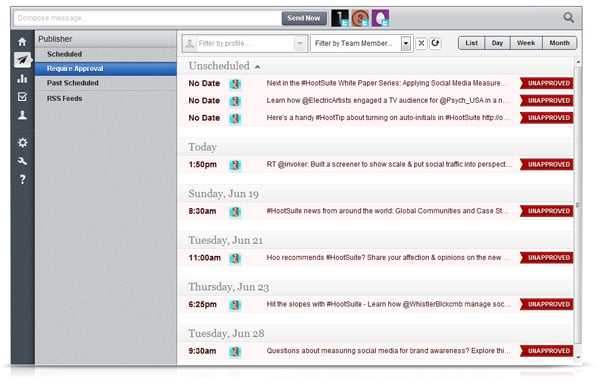
Since we may not have our schedules perfectly aligned to tweet or update our social networks at optimum times, HootSuite allows users to schedule their posts in advance.  As of June 15th 2011, HootSuite has made scheduling even easier.   Now you can slice and dice the destination profiles for each message and drag-and-drop your updates into time slots to match your editorial plans.
The whole power of daily/weekly/monthly calendar view (seen above) will soon only be available with Pro and Enterprise membership plans, but currently everyone can take the advanced scheduling functionality for a spin to see how calendar views can manage complex campaigns.
2. Limiting Permissions.
With this designation, collaborating interns, contractors and new recruits can share search streams and compose messages, but are limited from broadcasting directly to valuable company profiles. Instead, drafts are held for approval in the calendar view until a qualified Team Member pushes to the send queue. It’s ideal for ensuring accurate and appropriate updates.  Sadly, this is not a free tool, but if you plan on getting a lot of new blood to help you make content for your company's social media, it may be worth the investment.

How I Used HootSuite to Conduct 
a Successful Social Media Campaign for My Theater

1.  The first step was for me to define the goals of the campaign: I wanted to see more engagement (likes and comments) on the Rocklin Shakespeare Facebook page while teaching my viewers fun facts about the Bard.

2. Next, I took that goal and turned it into a game, a trivia challenge, to be exact.  I'd already written a great deal of Shakespeare Trivia Questions in preparation for another online game, so converting the questions into the proper format was easy.

3.  I added an incentive for users to play by offering a prize.  To get the ball rolling, I told users that it would take five "likes" on the post to uncover what that prize was, and launched into the game.  Oddly, users didn't seem to care what the prize happened to be, they were excited enough to be playing for a prize that they dove right in.  Eventually the status post got the five "likes" and I revealed three prize options: a Rocklin Shakespeare T-Shirt, a purse of ducats that was used as a prop in our production of The Taming of the Shrew, and the bragging rights of being featured with picture and bio on our Facebook hall of fame.

4.  But users were already engaged.  They didn't rush to unlock the prize, because liking that post wasn't worth any points.  Here was the first trivia question (last names are obscured for privacy):
Points were awarded to the first AND second responses with the correct answers.  This added a sense of urgency to the contest, and users rushed to be first and second.  To make the race fair, I always informed the viewers when to look for the next update.  This was easy to do, since I'd already scheduled the entire week-long contest in a few minutes on HootSuite.

5. At midnight, the answer was given along with an informative link about it.  Five minutes later, a bonus question appeared to reward viewers for checking the site at the appointed time.  The answer to the bonus question always featured in the informative link that came before it.  In this way, users would quickly learn to check posted links and would be rewarded for doing so.  Additionally, users got points for "liking" the bonus posts, which of course they did.

6.  I took this formula and repeated, with one question, one link and one bonus question each day for a week.  The final question was timed for noon on Saturday, which happens to be a peak time of the week for facebook sharing.

7. By analyzing the data on Facebook insights, saw that the contest increased the user interactions substantially.  Weekly post views rose by 217% and feedback increased by a staggering 3400%.  The campaign achieved its set goals.
The total cost of the contest was a T-Shirt (that I'd already had in overstock) and 99 cents in postage.  Again, using HootSuite I was able to type up and schedule a week's worth of facebook page updates in minutes.

Other Helpful Links:


Did you learn something useful from this post?  Click on the +1 button below so that others may find it when they search on Google.

Sunday, June 12, 2011

Marketing Monday: Why Theaters Should Tell Patrons to Turn ON Their Phones

Take a moment to imagine a scenario with me:

You arrive at the theater to watch a play.  The House Manager (or whomever fills the function) approaches the stage (or loudspeaker) and welcomes the crowd.

"Ladies and Gentlemen," they say, "thank you for joining us at [name of theater company] for [name of play].  At this time, I would like you to take out your cell phones and turn them on."

Now wouldn't that be surprising?

Here are a few things I would love for the House Manager to say next:

  • "Now send a text saying: fan [your page name] to 32665 or FBOOK to like us on Facebook."
  • "Now text 40404 with the message: follow [your username] to follow us on Twitter."
  • "Please turn on our Theater Friendly Phone Application while texting about the show in progress!"
First, I really don't understand why I have not seen this done.  Obviously the people coming into the theater like your organization enough to shell out for tickets, so capturing dozens (even hundreds) of new "likes" and followers each night should be easy!

But wait, what was that last bullet point?

New Idea: The Theater Friendly Phone App

This post was actually inspired by a story I read about a movie theater.  Apparently a patron became disgruntled when she was asked to turn off her cell phone during a movie and management had her thrown out.  The woman's indignation at the turn of events was recorded in a (probably) drunken phone call to the theater.  The theater's response with the ex-patron's inebriated rantings was to add captions and turn the recording into a YouTube video.

While I appreciate a good laugh, and want to smile at their creativity, I feel they're missing a big point:

People don't like to turn off their cell phones.

Even I feel apprehensive when I am unreachable for over two hours.  What if something happened to a family member?  Don't forget that many of those patrons hired a baby sitter and probably want to be contacted in case of an emergency.  So why not take on a huge chance to increase audience engagement for your theater by being the first to allow cell phone usage during a show or movie?  I think it's a great idea, considering that I've also mentioned some astonishing statistics from Google about how addicted Americans are to their phones.

For Review:
  • 72% use their phones while "consuming other media." A third of that use is while watching TV.
  • 39% use their phones while they're in the bathroom .
  • 20% would rather give up their cable TV before giving up their phones.

I want to see an app that:
  1. Is included with the purchase of a show/movie ticket (either as a free download with online purchase or as a QR Code on the physical ticket).
  2. Will dim the screen and mute all sounds on the phone to prevent any obstructions in visibility or audibility for other audience members.
  3. Blocks video recording (though how one would be able to sell a bootleg movie or show from a cell phone is beyond me).
  4. Prompts the user to "like" the theater on Facebook and follow it on Twitter.
  5. Logs ticket purchases and suggests new releases based on the user's preferences (like Netflix and more).
  6. Allows the user to tweet/update their Facebook about the experience at the theater and rate the movie or show.
Will this cause spoilers?  Not any more than usual.  I see most patrons getting on their phones as soon as they leave the theater anyway.  Why not let them talk about you for the two hours they're enjoying your service?

I'm probably going to be giving my code master a call... but in case he's busy: somebody should be doing this!

Controversially Yours,

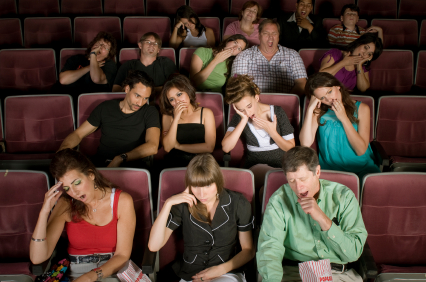
Photo courtesy of unreality.com.

Thursday, May 19, 2011

Theater Marketing Using 3 Social Networks: Proudly Presented in Bullet Points!

Hey there!  Dramatic Dissemination is back with more big Idea Blogs.  Today's topic covers ways to use three social networking sites to market your theater.  Off we go!

Facebook
  •          You have to create a page for your theater on facebook.  With over 500 million users, the website’s population is larger than every country except for India and China.  If you want to be seen, you have to be there.
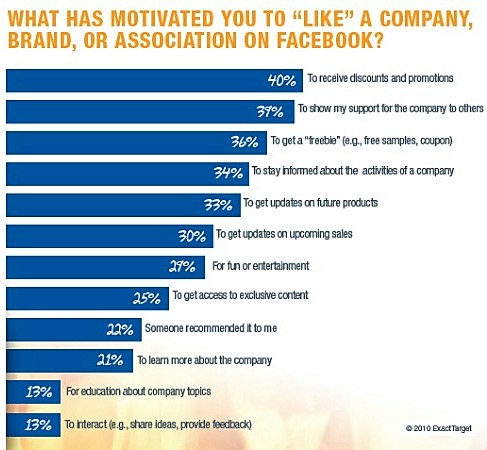
  •          However, when you make your page, keep in mind that the number one reason (at 40%)  facebook users “like” pages is for the purpose of obtaining exclusive promotions and discounts.  You have to give away a little on your facebook page to earn loyalty from your fans.  See the graph below for more reasons people will “like” you.


  •          Work to create true fans.  This means building a relationship with your fan base that allows them to identify with your brand.  Do not use your page for the sole purpose of impersonal updates like “come to our next show!”  or “great job everybody!”  Use your status updates to engage in a conversation with your fans, respectfully discuss their feedback and build a sense of identity between your fans and the culture of your theater.
  •         Set up a store on your facebook page. True fans want every chance they can get to show that they are a part of your theater.  Use that loyalty to promote your brand and bring more like minds into the fold.  Facebook stores typically secure 1-10% of a business’ fan base.  For a little perspective: in the 4th quarter of 2010, online sales were a record breaking $43.4 billion, +11% versus one year ago, according to comScore.


Twitter
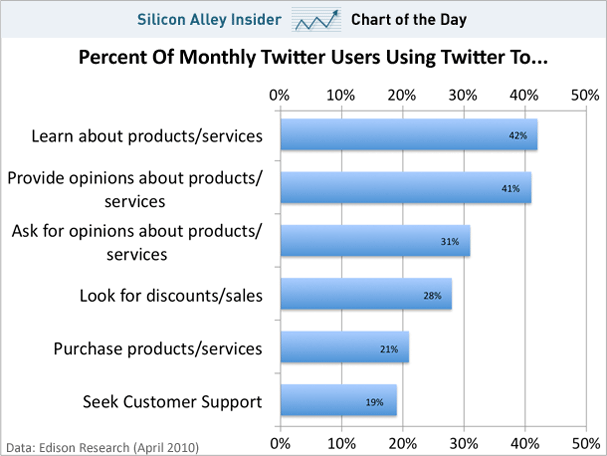
  •          Over 40% of the time that people are on Twitter, they are learning about products and services or providing opinions about brands.  If you aren’t on Twitter, they won’t be tweeting about you.
  •          Shocker: People actually spend a little over 20% of their time on Twitter BUYING products or services.  Again, if you aren’t on Twitter, the tweeters aren’t spending that purchasing power on you.  You’re missing out on ticket sales.  For other interesting ways that people are spending their time on Twitter, check the graph below.


  •        YouTube is the second largest search engine in the world.  Do you have a product or service that can be featured in front of a camera?  If you’re a theater, I have a feeling you do.  Get a YouTube channel for your theater, but read the Terms of Service agreement so that you understand what can happen to your content. 
  •          Content ownership technically belongs to the users, but YouTube's Terms of Service allows YouTube the licensing rights to use your content as they please until you delete it from the site.  So rather than uploading complete performance recordings that you are trying to sell, give samples and trailers.  Use Youtube for informational webcasts, behind-the-scenes bonuses, interviews with the artists and teasers for upcoming events.  Feature highlights from VIP parties for those valuable loyal fans and allow fans to upload their own footage from these events. 
  •          Always link these videos back to your main website, where you can feature/sell/rent your exclusive content.
  •          BONUS: A great idea that has yet to be used by a theater (at least to my knowledge) is a play, scene or passage done in the style of Virtual Choir.  I’ve certainly toyed with the idea of using this technique to produce an online version of Hamlet… or use it for an original play!

There are certainly more social networks to cover, but I’ve decided to keep my posts briefer in order to get them posted more frequently.  Speaking of social networks, why not connect with me on LinkedIn if you’d like to continue the conversation?  http://www.linkedin.com/in/danielleloebs

(Graph of “What has motivated you to “like” a company, brand or association on facebook?” courtesy of ExactTarget.  Chart of “Percent of Monthly Twitter Users Using Twitter To…” courtesy of Silicon Alley Insider from data collected by Edison Research.)

Wednesday, March 9, 2011

Improving the “Typical" Theater Experience Part One: Audience

In a world where nearly all forms of entertainment are accessible by computer or smart phone it is easy to view the act of seeing a play as something not only inessential, but downright obsolete.  In one sense, I agree.  Why should you pay upwards of twelve bucks to see The Sound of Music (or A Midsummer Night’s Dream, for that matter) for the umpteenth time when Oscar’s 2011 Best Picture is still playing at the local movie theater for the same price?  

If we are discussing most theater as we know it today, in both experiences you will be sitting in a dark room and required to be mostly passive and silent.  Perhaps the show will be entertaining and you will feel a sense of camaraderie with others in the audience who are laughing along with you during the performance/movie, but when the lights go up, then what?  Maybe you’ll be able to applaud at the live show and talk to a few actors who will politely nod before moving on to their friends and family, but in both the live theater and movie theater scenario you will likely leave the building with a head full of thoughts and opinions and no where to put them.

Though I cannot speak for everyone, I would call this my “typical theater experience” as an audience member.  This is not to critique the quality of the writing or acting in the plays I’ve seen, because so many have been excellent, but I usually leave the theater with a slight feeling of emptiness.  Correct me if I’m wrong, but I don’t think I’m alone in this.

So why does the experience need improvement?

If we focus a little bit on the movie theater model, it’s easy to measure success.  Looking at content, the highest grossing film of all time is James Cameron’s Avatar.  The draw for repeat viewings of this film was the fact that the 3D experience was vastly superior in the theaters; so much so that the film was re-released a few months later for a second triumph at the box office.  Audiences raved about the special effects and gave credit to advances in filmmaking technology.  The film was not the stand-out in writing, acting or plot (different films took home the Oscars that year) but the experience of watching the film was revolutionarily innovative for the industry.

By comparing** financial success in the movie industry with theater, the point I’m trying to make is not that live theater needs to heavily invest in special effects but that much more importance needs to be placed on the audience experience.  When I say that the “typical theater experience” needs to be improved upon, I am speaking specifically to that sense of alienation and emptiness generated in audience members leaving the theater after a performance.

At the beginning of this blog I noted that the increase in access to entertainment (thanks to ever-advancing technology) may be making the need for live theater obsolete.  However, this technology only makes entertainment broadly accessible at the individual level.  In other words, I don’t see large groups of people getting together in one room to watch their favorite TV show on their individual iPads… yet.

What I do see (and participate in) are social meetings on a virtual plane.  Facebook is the greatest example of this kind of activity, where people log in to be social on their own time.  They may not have direct contact with their friends, but they leave messages that produce a similar (if not slightly more superficial) sense of socialization.  Diane Ragsdale notes in her article, Recreating Fine Arts Institutions that “Americans live in an increasingly free, time-shifting, do-it-yourself culture.  Fully half of all teens have created a blog or Web page, posted original artwork, photographs, stories or videos online, or remixed online content into their own creations.”  In these terms, our culture has never before had a stronger sense of creativity, yet little of it seems to be transferring to the audience experience at the local theaters.

Is it possible for theaters to harness the creativity of their audiences?  Can technology that is used to create virtual social spaces enhance the social experience of audience members who are together in a physical space?  By embracing what technology has facilitated in America as a culture of change, can theaters adapt their models to not only be more elastic but also allow for DIY participation from their audiences?

Yes.  Yes.  Yes.

I believe it is entirely possible for theaters to do all of these things.  The first step is simply allowing the public to participate in multiple levels of engagement at strategic points along the artistic process.  To illustrate what I mean, I will list examples and place them on something I call “the active engagement scale.”  

Ms. Ragsdale details one example:
“Four years ago, Chicago’s Steppenwolf Theatre launched First Look 101, in which they invite 101 patrons to join them at important steps of developing a new play.  Most arts organizations offer behind-the-scenes opportunities only for major donors.  First Look 101, however, is affordable ($45 for students and $75 for others) and open to anyone.  The three-month program gives people the chance to attend an unrehearsed table reading, the first day of rehearsal (including designer presentations), a rehearsal involving blocking an scene work, a technical rehearsal (when elements such as lights and sound are incorporated), and a final performance.”

This example is what I would designate to the lower end of the active engagement scale.  Though the program demystifies the artistic process and allows audiences to look at and listen to what the theater is doing in the stages before opening night, they are not asked to give feedback nor are they given opportunities to create.

Arena Stage also developed a “First Look” style program called “Theater 101” but added an important component.  They note on their site that “each event will be followed by a discussion moderated by Arena artistic staff.”  The discussion opportunity raises this program to the moderate level of engagement on the scale as audiences are given a chance to express their opinions and ideas.  Still, the creativity of the audience is left largely untapped.

Because so many opportunities for creative expression are available online, I think one of the easiest ways for audiences to reach the high end of the active engagement scale (where they are observing, reflecting, expressing AND creating) is to give them a voice on the theater organization’s website.  One example of this comes from On the Boards, who invited “members of their community” ---including audience members--- to publish their impressions about performances on the Blog the Boards section of the organization’s website.  Risky?  Possibly, though it appears blog posts were moderated to prevent any personal attacks.  Successful?  It appears so!  There was a large quantity of blogs (spanning several years) and those I clicked at random were insightful and well-written: a definite improvement on most fan forums I’ve seen in the past.


Another example of high active audience engagement would be performances that actually take audience volunteers to participate in the show.  Improvisational comedy (like that on Whose Line is it, Anyway?) is often reliant on audience suggestions and ideas to craft the performance.  Productions that follow the format of Augusto Boal’s Theatre of the Oppressed allow audience members to “pause” a performance and step into the action on stage in order to solve the problems created by the actors in the scene.  In both examples, audiences can voice their opinions and suggestions to directly affect the show and create new outcomes.

All of these examples are given to show that theaters are trying interesting and innovative techniques to engage their audiences at multiple levels of activity.  Perhaps these specific methods are not all appropriate for my local theaters, but they certainly help to get ideas flowing.

In a culture of change, it is important that the theater experience does not fall into the category of “typical.”  We are all far too creative for redundancy.

**Supplementary Explanation of Comparing For-Profit to Non-Profit Businesses:
Most live theater organizations are not for-profit businesses, so it is not always easy to draw accurate comparisons.  For a movie theater, the audience decides with their dollars about what appeals to them, but the measure of a non-profit’s success is a little more complex.   To begin, a non-profit, while allowed to make a profit (or more accurately, a “surplus”), cannot distribute that income to its members (the equivalent of this would be a corporation paying dividends to its share holders).  Those earnings must be retained by the organization for its self-preservation, expansion and future plans.

With this in mind, the first priority of a non-profit organization (by law) is to its mission.  Mission statements for non-profit theaters fall under the “Public Benefit Non-Profit Corporation” category, which is restricted to “businesses formed for scientific, charitable, literary, or educational purposes.”  The following is an example of a non-profit theater’s mission statement:

[City Name] Rep's mission is to stimulate, celebrate and enhance understanding of ourselves and others through the shared experience of live theatre by producing new plays and classics marked by innovative interpretations and a reflection and inclusion of our community and the world in which we live.

The key phrase in this statement is “enhance understanding” which relates to the “educational purpose” aspect of a non-profit mission statement.  If the theater achieves its mission through its operations, one could argue that it is a successful non-profit, even if it has lost money.  Of course, if the non-profit continues to lose money it will not be able to maintain the operations that achieve its mission, therefore a positive revenue stream can be a supplementary measure of the non-profit’s lasting success.

In contrast, the basic “mission” of a for-profit business is simply to make a profit.  The commonality is that not losing money helps both kinds of businesses, no matter where their priorities lie.